Table of Contents
The construction industry is undergoing a massive seismic shift. As global pressure mounts to reduce carbon emissions, cement manufacturers are moving away from traditional Ordinary Portland Cement (OPC) toward sustainable alternatives like Green Cement. These eco-friendly variants, which utilize industrial by-products like fly ash, slag, or calcined clay, promise a significantly lower carbon footprint.
However, a great idea and a noble environmental goal are not enough to get a plant built. The bridge between a concept and a fully operational facility is capital. For investors and financial institutions, “green” is a positive buzzword, but “profitability” and “risk mitigation” are the laws they live by.
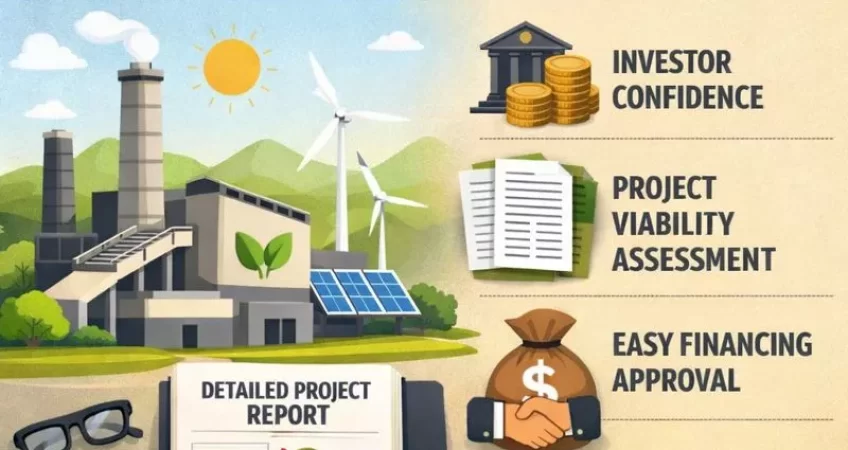
This is where a Bankable Detailed Project Report (DPR) becomes the most critical document in your arsenal. Without it, even the most innovative green cement project is likely to stall on the drawing board. At TECHCEM Consultancy and Engineering Pvt. Ltd., we understand that securing funding is the first major hurdle, and a robust DPR is the tool to clear it.
What is a Bankable DPR?
A Detailed Project Report (DPR) is the blueprint of your entire business venture. It covers everything from the technical selection of machinery to the marketing strategy for the final product.
However, there is a distinct difference between a standard DPR and a bankable DPR.
A standard DPR might focus heavily on the engineering and technical feasibility which is vital but a bankable DPR is written specifically for the eyes of lenders and investors. It translates technical capability into financial certainty. It answers the questions that keep bankers up at night:
- Is the raw material supply chain secure for the next 20 years?
- Is the technology proven, or is it an expensive experiment?
- What is the Debt-Service Coverage Ratio (DSCR)?
- What are the sensitivity analyses if market prices drop?
In essence, a bankable DPR is a comprehensive risk assessment and financial roadmap that convinces a financial institution that lending money to this project is a safe bet.
Why Green Cement Projects Face Higher Scrutiny
Securing finance for green cement is often more complex than for traditional cement plants. Lenders are naturally conservative and green cement introduces variables that standard models might not account for.
1. Technology Risks
Green cement often relies on newer technologies or specific chemical activations (like alkali-activated binders or LC3 technology). While engineers know these work, bankers may view anything deviating from the 100-year-old OPC standard as a “technology risk.” A bankable DPR must provide technical due diligence that proves the viability and longevity of the chosen technology.
2. Supply Chain Volatility
Traditional cement relies heavily on limestone. Green cement, however, relies on supplementary cementitious materials (SCMs) like fly ash from power plants or slag from steel plants. A bankable DPR must prove that the project has secured long-term contracts for these materials. If a power plant shuts down, where will the fly ash come from? The DPR must answer this.
3. Market Acceptance
Will the local construction market accept this new product? Contractors are creatures of habit. A bankable DPR includes a deep-dive market study proving that there is demand for green cement in the target geography and that the pricing strategy is competitive against traditional cement.
Key Components of a Bankable DPR for Green Cement
To satisfy international lending standards and local banking regulations, a DPR must be exhaustive. When TECHCEM Consultancy and Engineering Pvt. Ltd. prepares these reports, we ensure the following pillars are rock-solid:
Technical Feasibility and Technology Selection
This section justifies the machinery and the chemistry. It details the clinker factor reduction, the specific grinding technologies used to handle harder materials like slag, and the energy efficiency of the proposed plant. It must validate that the chosen equipment is capable of producing cement that meets rigorous quality standards (such as ASTM or EN standards).
Raw Material Assessment
For green projects, this is non-negotiable. The report must include geological surveys for limestone (if applicable) and legally binding MOUs or contracts for SCMs. It assesses the logistics of getting these materials to the site transportation costs can often kill a project’s margins, so this analysis must be precise.
Environmental Impact and Sustainability
Since the selling point is “Green,” the DPR must quantify it. This involves calculating the projected carbon footprint per ton of cement produced. It should also detail water consumption, waste management systems and compliance with local environmental control board norms.
Financial Modeling and Sensitivity Analysis
This is the heart of the “bankability.” It includes:
- Total Project Cost: A realistic breakdown of CAPEX (Capital Expenditure).
- OPEX Estimates: Detailed operating costs, including power, fuel and labor.
- Profitability Ratios: IRR (Internal Rate of Return), NPV (Net Present Value) and Payback Period.
- Sensitivity Analysis: What happens to the cash flow if coal prices double? What if cement prices drop by 10%? The model must show the project can survive these shocks.
The Benefits of a Professional, Bankable DPR
Cutting corners on your DPR is a false economy. Investing in a high-quality report prepared by industry experts offers immediate advantages.
- Accelerated Financial Closure: Banks work faster when they don’t have to ask for clarifications. A complete, professional report allows credit committees to make decisions quickly, reducing the time between concept and construction.
- Lower Cost of Capital: Perceived risk drives interest rates. A DPR that clearly identifies and mitigates risks can help negotiate better loan terms. If you can prove your project is safe, you shouldn’t have to pay a “high-risk” premium.
- Realistic Roadmapping: Beyond funding, a good DPR acts as a manual for the project owners. It sets realistic timelines and budget expectations. It prevents the common pitfall of undercapitalization, where a project runs out of money when the plant is 90% built.
Building a Foundation for Success
The transition to Green Cement is necessary for the planet and profitable for the astute business owner. But the complexity of these projects demands more than just optimism. It requires rigorous planning and financial transparency.
A bankable DPR is not just a requirement for a loan application; it is a stress test for your business model. It forces you to address weaknesses before ground is broken and money is spent.
At TECHCEM Consultancy and Engineering Pvt. Ltd., we specialize in cement plant consultancy services that bridge the gap between engineering excellence and financial viability. By ensuring your green cement project is backed by a watertight DPR, you are doing more than just planning a factory you are securing its future.