
Table of Contents
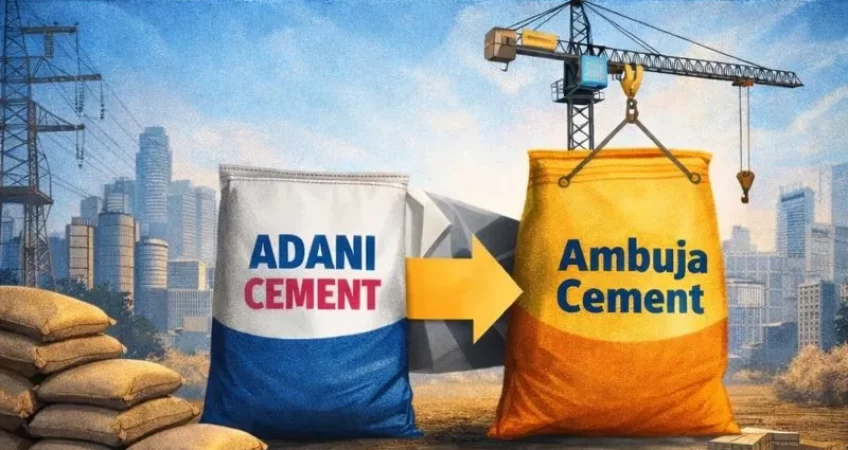
After investing close to $10 billion in just three years to build India’s second-largest cement portfolio, the Adani Group is now taking its next logical step simplifying its corporate structure. The group has moved to consolidate its cement assets by merging ACC Ltd and Orient Cement Ltd into Ambuja Cements Ltd, creating a single, streamlined operating platform.
The board of Ambuja Cements has approved the merger, which is expected to take about 12 months to complete, subject to approvals from shareholders, creditors, and regulators. Following the announcement, Ambuja’s shares rose by 2%, reflecting investor confidence in the consolidation strategy.
A Push to Reduce Complexity
Since entering the cement sector in 2022 with the acquisition of Holcim’s Indian operations, Adani has rapidly expanded through multiple purchases. While this helped the group achieve scale quickly, it also resulted in a multi-layered corporate structure with overlapping subsidiaries.
The proposed merger brings ACC and Orient Cement directly under Ambuja, which already holds 50.05% in ACC and 72.66% in Orient. Earlier, Ambuja had also approved the amalgamation of Sanghi Industries and Penna Cement, signaling a broader plan to unify assets acquired over a short span.
This consolidation removes structural duplication, lowers administrative costs, and allows faster decision-making across the cement business.
Under the approved swap arrangement:
The merger terms provide ACC shareholders with Ambuja shares based on a 328-to-100 exchange ratio.
The swap ratio for ACC broadly reflects current market pricing, while Orient Cement shareholders receive a modest premium. After all mergers are completed, promoter holding in Ambuja is expected to decline, improving public float and balance-sheet flexibility.
Stronger Operations, Better Margins
Post-merger, Ambuja and ACC brands will continue independently, but operational control will rest within a single corporate entity. All assets and liabilities—including brands, trademarks, reserves, and obligations—will move into Ambuja’s standalone financials.
According to the company, this is expected to improve margins by at least ₹100 per tonne through procurement efficiencies, logistics optimization, and reduced branding and sales costs.
Analysts See Long-Term Gains
Market analysts view the move as a strategic cleanup exercise rather than a growth gamble. Brokerages note that the merger improves capital efficiency, strengthens synergy realization, and positions Ambuja as a more agile, pan-India cement player.
Cost savings and margin improvement are expected to become visible between FY26 and FY28, as operational integration stabilizes.
Building Scale in a Competitive Market
Adani’s cement journey began with the $6.5 billion acquisition of Holcim’s India businesses. Since then, the group has added Sanghi, Penna, and Orient Cement, bringing total capacity to 107 million tonnes per annum, second only to UltraTech Cement.
With this merger, Adani is signaling a shift from rapid acquisition to consolidation and efficiency, aiming to unlock long-term value from the scale it has already built.
The Bottom Line
Folding its cement assets into Ambuja allows Adani to move from expansion mode to optimization mode. By simplifying structure, reducing costs, and improving operational control, the group is laying the groundwork for a more competitive and financially resilient cement business in India.