
Table of Contents
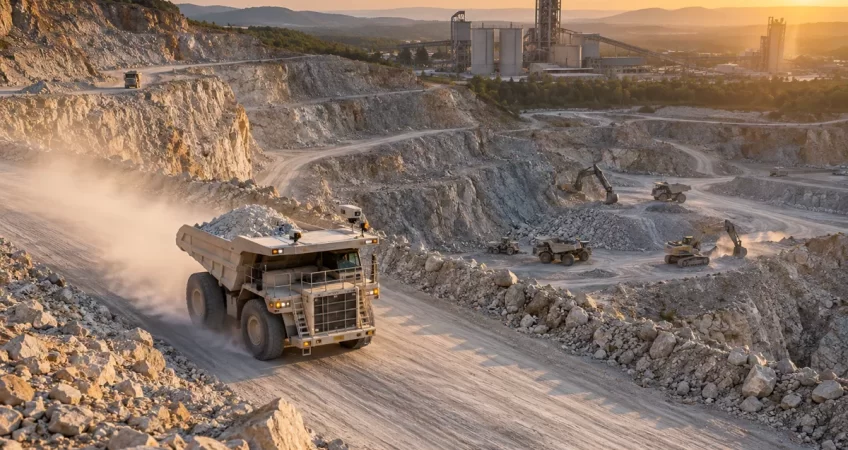
Quarrying is where a cement plant’s raw material story begins, and it’s also one of the last parts of the operation to see serious automation. That is changing. Autonomous drilling, hauling, and survey technologies — proven first in large-scale mining — are now being adapted for the smaller, more variable limestone quarries that feed cement plants.
This shift matters because quarry inefficiency and material inconsistency ripple through the entire plant, affecting everything from raw mix design to kiln stability. Autonomous quarry operations are one of the more direct ways to address that at the source.
What Autonomous Quarry Operations Actually Cover
“Autonomous quarry operations” is not a single technology — it’s a set of systems that reduce the need for continuous human operation across quarry activities, including:
- Autonomous or semi-autonomous haul trucks running fixed or dynamically optimized routes
- Automated drilling rigs that follow pre-programmed blast patterns
- Drone-based surveying and stockpile volume measurement
- Remote and automated crusher and conveyor monitoring
- Fleet management software that coordinates equipment in real time
Why Cement Plants Are Adopting This Now
A few converging factors are pushing quarry automation from mining giants down into mid-size cement operations:
- Falling sensor and connectivity costs have made autonomous systems viable at smaller scale than five years ago
- Labor availability for skilled quarry equipment operators is tightening in many regions
- Safety pressure — quarry blasting, drilling, and haulage are among the highest-risk activities in cement production, and removing operators from the most hazardous zones is a direct safety win
- Raw material consistency demands — tighter kiln and mill operating windows mean plants can no longer tolerate the raw material variability that comes from inconsistent manual quarry management
Core Benefits
- Consistent raw material feed. Automated systems follow the same extraction pattern every time, reducing the chemistry swings that come from operator-to-operator variation.
- Lower cost per tonne extracted. Optimized haul routes and reduced idle time cut fuel consumption and equipment wear.
- Improved safety. Fewer personnel exposed to blast zones, unstable benches, and heavy equipment traffic.
- Better data for raw material investigation. Drone surveys and automated sampling generate far more granular quarry data than periodic manual surveys.
- 24/7 operating capability in conditions where visibility or fatigue would otherwise limit manual operation.
Where the Technology Is Still Maturing
Autonomous quarry systems are proven in large open-pit mining but adoption in cement-scale quarries is still early, and plants evaluating it should go in with realistic expectations:
- Smaller, irregular quarry geometries (common in cement operations versus large-scale mining) are harder to automate than the large, uniform benches autonomous systems were originally designed for
- Connectivity infrastructure (reliable wireless coverage across the quarry) is a prerequisite most sites need to build before automation is possible
- Integration with existing fleet and ERP systems requires dedicated engineering effort, not just equipment purchase
- Capital cost is significant, and the payback case depends heavily on quarry scale and existing labor cost structure
A Practical Path to Adoption
Most cement plants don’t move to full quarry autonomy in one step. A more typical progression looks like:
- Start with drone-based surveying and stockpile measurement — the lowest-risk, fastest-payback entry point
- Add semi-autonomous features (collision avoidance, route optimization) to existing haul trucks before considering full autonomy
- Pilot automated drilling on a defined section of the quarry before a full rollout
- Build the connectivity and fleet-management backbone before committing to fully autonomous haulage
Final Perspective
Autonomous quarry operations are less about replacing quarry teams and more about giving cement plants tighter, more consistent control over the raw material that determines everything downstream — clinker chemistry, kiln stability, and product quality. For most plants, the sensible starting point is improving quarry data quality first, since that’s what any automation investment will ultimately be judged against.
Need expert help with this? See how TECHCEM’s raw material investigation services can support your project. You may also find our guide on drone-based limestone mine surveying useful as a practical first step toward quarry automation.