
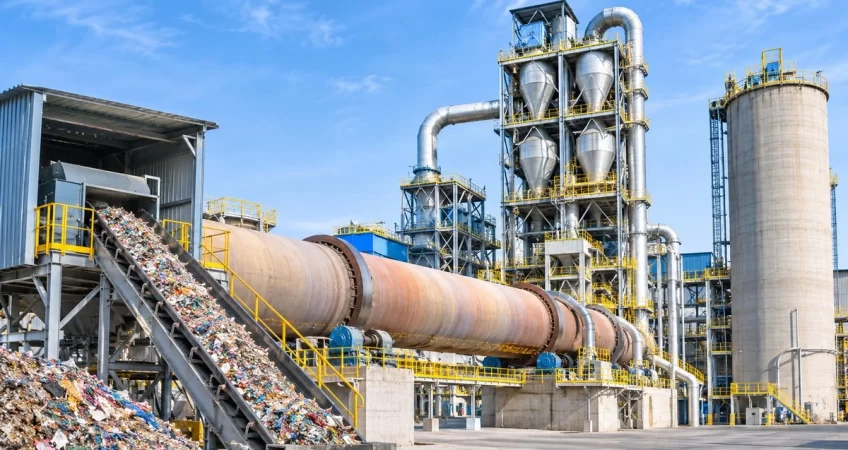
Indian cement plants currently take about 6 percent of their kiln heat from biomass and refuse derived fuel. The figure recommended for 2030 is 20 percent. Tripling the thermal substitution rate is the stated direction, and most plants have a target without a plan, because the target is a number and the plan is a list of physical changes to the plant.
It is worth knowing that 20 percent is not ambitious by world standards. The global average thermal substitution rate was already 16.7 percent in 2016, up from 2 percent in 1990, with Europe at 44.2 percent. Germany averaged around 65 percent in 2017 and some European plants have reached 100 percent. One Chinese operation, Huaxin, reached 54 percent running 700 tonnes per day of RDF. So the engineering is well established. What is not established is what any particular Indian plant has to do to get there.
This article sets out what actually has to be built, measured and controlled, and the order in which the work pays.
Where India’s Thermal Substitution Rate Sits, and Why the Gap Is Not Technical
India is not a laggard on efficiency. Indian plants average roughly 731 kilocalories per kilogram of clinker thermal and about 73 kilowatt hours per tonne of cement electrical, against global averages near 838 and 104 respectively. The kilns are modern and well run.
The alternative fuel gap is therefore not a competence gap. It is an infrastructure and supply chain gap. Raising the thermal substitution rate needs waste that arrives with known properties, a place to put it, equipment that can prepare it, feed points that can accept it, and a kiln chemistry that tolerates what comes with it. Each of those is a separate piece of work, and a plant that orders a feeding system without the other four gets a feeding system and no substitution rate.
Fuel Properties Decide Everything Downstream
Before any equipment decision, the fuel has to be characterised. The properties that matter are calorific value, moisture, ash, chlorine and sulphur, heavy metals, organic content, mineralogy, granulometry and flash point. Each one affects something specific: emissions, health and safety, kiln operation or product quality.
For context on what typical material looks like, RDF produced from municipal solid waste is often around 35 percent moisture with a net calorific value of 8 to 10 gigajoules per tonne. Oil sludge averages nearer 15 gigajoules per tonne but varies considerably by source.
Three of these properties deserve singling out because they are where plants get caught.
Moisture is the quiet one. At 35 percent moisture, a large share of the calorific value you are buying goes into evaporating water. That water becomes gas volume, which loads the fan, and if the gas circuit has no spare capacity the fan becomes the constraint on how much AFR you can actually fire. This is why fan capacity assessment belongs at the start of an AFR project and not at the end.
Chlorine is the one that stops plants. Alternative fuels commonly carry 0.05 to 1 percent chlorine, with solid recovered fuel averaging around 0.7 to 0.8 percent, and only a small fraction of it fixes into the clinker. The rest recirculates and enriches. This is the mechanism behind preheater plugging on plants that raised their thermal substitution rate without checking, and it is covered properly in our piece on alkali, chlorine and sulphur circuits and when a bypass becomes necessary. Establish the chlorine balance before committing to a thermal substitution rate target, not after.
Mercury is a hard exclusion rather than a parameter to manage. A cement kiln cannot retain it, so it should be avoided at the acceptance stage. There is no process solution downstream.
Pre-processing Is Usually the Real Project
Very little waste can go straight into a kiln. Whole tyres are the main exception. Almost everything else needs preparing, and the preparation is where the capital and the operating complexity sit.
For solid waste, pre-processing means sorting, blending, size reduction and drying, typically through mechanical treatment such as two stage shredding with air separation, or mechanical biological treatment where the organic content is significant. For liquids and sludges it means blending, removing oversized solids, and sometimes physico-chemical treatment such as mixing with an adsorbent like sawdust.
The objective is a single word that is worth remembering: homogeneous. The purpose of pre-processing is to produce qualified homogeneous fuel, because a kiln can be tuned to a consistent fuel of almost any specification and cannot be tuned to a fuel that changes every hour. Variability, not calorific value, is what destabilises kilns.
A useful design principle from the published guidance is that a pre-processing line should be able to handle different materials at different times, so recycling and co-processing can be balanced as the waste supply changes. A line built for one feedstock becomes a liability when that feedstock gets diverted elsewhere.
Matching the Fuel to the Feed Point
There are three places to put fuel into a kiln system and they are not interchangeable.
- Kiln inlet suits whole tyres and coarse material that needs residence time at high temperature.
- Precalciner suits coarse solid alternative fuels, which is where most RDF goes.
- Main burner suits liquid fuels and finely prepared material.
One rule overrides convenience. Material with high volatile organic content must go only into the high temperature zone. Introducing volatiles where the temperature or residence time is insufficient gives incomplete combustion, which means CO, odour and potentially organic emissions, and it is a compliance failure rather than an inefficiency.
Choosing feed points determines a surprising amount of the rest of the design: the pre-processing specification, the conveying route, the dosing accuracy required, and whether the calciner has enough residence time for the particle size you intend to fire. Getting this sequence right is cement plant process design work, and it is cheaper to resolve on paper than to correct after the feeding system is installed.
Storage, Handling and the Fire Problem
This part is routinely underestimated because it looks like civil work rather than engineering.
Storage has to suit the material. Liquid sludge goes into pits, dry sludge onto concrete yards, and solid prepared fuel into covered sheds with reclaim. Beyond the containment itself, the facility needs controls for vapours, odours and dust, prevention of infiltration into soil or water, and documented spill response and emergency plans.
Fire protection is not optional and should be designed in rather than added. Published implementations include fire detection, alarm and firefighting systems as part of the standard scope for an RDF feed system, alongside reception and storage and the dosing and feeding equipment. Prepared alternative fuel is a combustible material held in bulk, often with dust, often with a biological component generating heat. Treating its storage like a clinker shed is the mistake that produces an incident.
The static earthing and bonding of the handling system belongs here too, and it is frequently the item that falls between electrical and mechanical scopes. Flexible connections, rotary valves and non-conductive liners can isolate sections that the design assumed were electrically continuous, in an area where static is an ignition source. Our note on earthing and lightning protection for a cement plant covers why that gap appears.
Acceptance Control Is What Makes It Sustainable
The difference between a plant that holds a high thermal substitution rate and one that achieves it briefly is almost always acceptance control.
Each delivery should be sampled and tested against pre-acceptance criteria, with traceability maintained from reception through to final treatment. That sounds bureaucratic until the first consignment arrives at double the expected chlorine, or wet, or containing something that was not declared. Without incoming control, the plant is running an experiment on its own kiln every time a truck arrives.
One operating rule is worth writing into the procedure explicitly: alternative fuel should be excluded during kiln start up and shut down. Those are the periods with the least stable temperature and gas conditions, which makes them precisely the wrong time to introduce a variable fuel.
Emissions and the Compliance Boundary
The governing principle in the published guidance is clear and sets the bar for the whole project: emissions to air and water shall not be higher than from cement production without co-processing.
That reframes co-processing correctly. It is not a licence to emit more because the plant is handling waste. It is permission to substitute fuel provided the stack does not get worse. Some parameters require continuous monitoring and others annual testing, and the obligation runs for the life of the operation.
A second principle matters for product credibility: the product, meaning the concrete and mortar made from the cement, must not become a sink for toxic elements such as heavy metals. That is what drives the heavy metals acceptance criteria rather than any process concern, and it is the reason acceptance limits cannot be relaxed to accommodate a cheap consignment.
The Order of Work That Pays
- Establish the waste supply before designing anything. What is genuinely available within economic transport distance, in what quantity, with what consistency, and under what commercial terms. A plant designed for fuel that is not reliably available has bought a very expensive building.
- Characterise it properly. Calorific value, moisture, ash, chlorine, sulphur, heavy metals, organics, granulometry. Multiple samples across time, not one certificate.
- Run the chlorine and volatile circuit balance. This is the step that decides whether your target substitution rate is achievable at all without a bypass, and it is the cheapest step on the list.
- Check the gas circuit and fan capacity against the additional volume that moisture and combustion air will generate. This frequently sets the real ceiling on the thermal substitution rate you can hold.
- Select feed points and size the pre-processing to match, rather than specifying pre-processing first and discovering the feed point cannot take the product.
- Design storage, handling and fire protection as one system, including static bonding, containment and emergency response.
- Build the acceptance and monitoring regime before the first delivery, including sampling, pre-acceptance criteria, traceability and the emissions monitoring obligations.
Steps 3 and 4 are where plants discover whether their target is realistic, and both are measurement exercises rather than capital projects. Doing them first either confirms the plan or saves the money. That assessment work sits naturally within a cement plant energy audit, and the resulting capital case belongs in a cement plant feasibility study that prices the pre-processing, the fire protection and any bypass alongside the fuel saving rather than after it.
What Else Changes When Substitution Rises
Two consequences of a higher thermal substitution rate are worth planning for, because they arrive later and get blamed on something else.
The refractory lining faces a different chemical environment. More alkali, chlorine and sulphur circulating means more aggressive attack and more build-up, and a lining specified for straight coal firing may not survive at a high thermal substitution rate. This is a specification review, not a maintenance issue, and it belongs with cement kiln refractory engineering.
The clinker chemistry shifts because the ash from alternative fuel becomes part of the raw mix. Ash content and composition have to be accounted for in the mix design rather than treated as a contaminant, and a change of fuel source changes the correction required.
Neither is a reason not to raise substitution. Both are reasons to raise it with the chemistry in front of you. The broader commercial context for why plants are doing this at all is covered in our piece on alternative fuel strategies for cement plants.
FAQs:-
What is thermal substitution rate?
It is the share of a kiln’s heat input supplied by alternative fuels rather than conventional fossil fuels such as coal and petcoke, expressed as a percentage of total thermal energy. It is measured on heat supplied, not on tonnes fed, which matters because alternative fuels generally have lower calorific value than petcoke, so a given tonnage displaces less fuel than it might appear. Indian plants currently average around 6 percent from biomass and RDF, against a recommended 20 percent by 2030.
Why is India at 6 percent when Europe is above 40 percent?
Not for technical reasons. Indian kilns are efficient, averaging roughly 731 kilocalories per kilogram of clinker thermal against a global average nearer 838. The gap is in waste supply infrastructure, in the consistency of material reaching the plant, and in the pre-processing and feeding equipment installed. Global average substitution was 16.7 percent in 2016 with Europe at 44.2 percent, Germany averaging about 65 percent in 2017, and some plants reaching 100 percent, so the engineering is well proven.
What limits how much alternative fuel a kiln can take?
Usually one of three things rather than the burner. Chlorine input, because it recirculates and enriches in the preheater until build-ups stop the plant. Gas volume, because moisture in the fuel generates additional gas that the induced draft fan has to move, and a fan at its limit caps substitution directly. And residence time at the chosen feed point, because coarse material fired where there is insufficient time or temperature burns incompletely. All three are measurable before any equipment is ordered.
Do we need a chloride bypass to raise substitution?
Not necessarily, and the answer depends on a measurement rather than a rule. Alternative fuels commonly contain 0.05 to 1 percent chlorine, with solid recovered fuel around 0.7 to 0.8 percent, and only a small share fixes into the clinker while the rest recirculates. Whether that pushes your plant past its tolerance depends on the total chlorine input from all sources, including raw materials. Establish the balance first. If one input dominates, changing that input is far cheaper than installing a bypass.
Which feed point should alternative fuel go to?
It depends on the fuel. Whole tyres and coarse material needing high temperature residence go to the kiln inlet. Coarse solid alternative fuels, including most RDF, go to the precalciner. Liquid fuels and finely prepared material go to the main burner. One rule overrides preference: material with high volatile organic content must go only into the high temperature zone, because introducing volatiles where temperature or residence time is insufficient causes incomplete combustion and becomes a compliance problem rather than an efficiency one.
How much pre-processing does waste derived fuel need?
Most waste needs substantial preparation, with whole tyres being the main exception that can go directly to the kiln. Solid waste typically requires sorting, blending, size reduction and drying, often through two stage shredding with air separation, or mechanical biological treatment where organic content is significant. Liquids and sludges need blending, oversize removal and sometimes mixing with an adsorbent. The objective is homogeneity, because a kiln can be tuned to a consistent fuel of almost any specification but not to one that changes hourly.
Does co-processing increase stack emissions?
It should not, and the governing principle in published guidance is explicit: emissions to air and water shall not be higher than from cement production without co-processing. Some parameters require continuous monitoring and others annual testing, for the life of the operation. A separate principle protects the product, requiring that concrete and mortar do not become a sink for toxic elements such as heavy metals, which is what drives heavy metal acceptance limits. Mercury is excluded outright because a kiln cannot retain it.
Will higher substitution affect our refractory and clinker quality?
Both, and both should be planned for rather than discovered. More alkali, chlorine and sulphur circulating creates a more aggressive environment for the lining and more build-up, so a refractory specification written for straight coal firing may not survive at a high substitution rate. Separately, ash from the alternative fuel becomes part of the raw mix, so its content and composition have to be accounted for in mix design, and a change of fuel source changes the correction needed.