
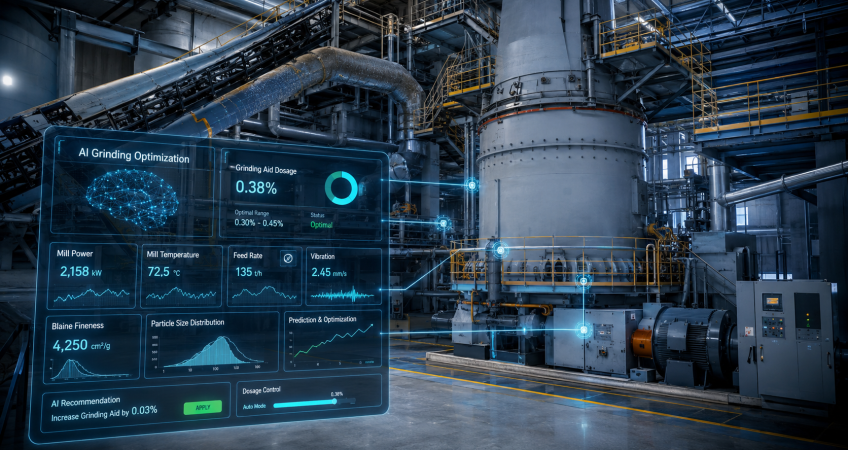
Grinding Aids Optimization Using AI is changing how cement plants think about mill performance. For decades, grinding aid dosing relied on manual sampling, operator experience, and periodic lab checks. That approach worked, but it left a lot of efficiency on the table. Today, plants are turning to machine learning models and real-time sensor data to dose grinding aids with a precision that manual methods simply cannot match.
For cement manufacturers under pressure to cut energy costs and meet tighter quality specs, this shift matters. This article breaks down how AI-driven grinding aid optimization works, where it delivers the most value, and what plants should consider before implementing it – with insight from Techcem Consulting and Engineering, a firm that works directly with cement producers on process improvement.
Why Cement Mills Need AI-Powered Grinding
Grinding aids are chemical additives – typically amines, glycols, or specialty blends – introduced during clinker grinding to reduce particle agglomeration and improve mill efficiency. Dosage has traditionally been set using fixed rates or occasional manual adjustments based on lab feedback.
The problem is that clinker composition, mill temperature, humidity, and feed rate change constantly. A dosage that works well in the morning may be wasteful or insufficient by the afternoon. This is exactly the kind of dynamic, multi-variable problem AI models are built to solve.
How AI Models Learn Mill Behavior
Machine learning models trained on historical mill data can learn the relationship between grinding aid dosage, feed characteristics, and output fineness. Once trained, these models can recommend or automatically adjust dosage in near real time, responding to conditions far faster than a human operator ever could.
Key Ways AI Optimizes Grinding Aid Dosage
AI-driven systems typically improve grinding operations across several connected areas:
- Dynamic dosage control — adjusting grinding aid input in real time based on live mill data rather than fixed schedules
- Cement mill efficiency gains — reducing over-grinding and cutting the time needed to reach target fineness
- Lower energy consumption — since grinding accounts for a large share of a cement plant’s electrical load, even small efficiency gains translate into meaningful power savings
- Higher productivity — more consistent throughput with fewer manual interventions
- Continuous process parameter monitoring — tracking mill temperature, vibration, feed rate, and particle size distribution simultaneously
- Improved cement quality — more consistent Blaine fineness and particle size distribution, which supports strength development
- Early detection of performance variations — flagging abnormal mill behavior before it causes downtime or quality deviations
- Predictive decision-making — using trend data to anticipate maintenance needs and dosage adjustments before problems occur
Each of these functions on its own offers incremental value. Combined, they represent a meaningful shift in how a cement plant runs its grinding circuit day to day.
Practical Industrial Applications
Real-Time Dosage Adjustment on the Mill Floor
Sensors feed live data – mill differential pressure, power draw, material temperature – into a predictive model that recommends dosage changes. Operators can either review these recommendations or, in more mature installations, allow automated control loops to apply them directly.
Energy Consumption Reduction
Since grinding is one of the most energy-intensive stages of cement production, AI models that fine-tune dosage and mill loading can produce measurable reductions in kWh per tonne of cement produced. This directly supports both cost control and sustainability reporting.
Quality Consistency Across Batches
By correlating grinding aid dosage with resulting fineness and strength data, AI systems help plants hold tighter tolerances, reducing rework and off-spec material.
Predictive Maintenance Signals
Gradual shifts in mill vibration or power draw, picked up early by AI monitoring, often indicate wear in liners or grinding media well before a failure occurs.
Benefits of AI-Based Grinding Aid Optimization
- Reduced specific power consumption per tonne of cement
- More stable particle size distribution and product quality
- Fewer manual dosage adjustments and less operator guesswork
- Faster identification of abnormal mill conditions
- Better data for long-term process improvement decisions
Implementation Considerations
Adopting AI for grinding aid optimization is not a plug-and-play exercise. Plants typically need to address a few things first:
- Data readiness — reliable sensors and historical process data are the foundation any model is trained on
- Integration with existing DCS/SCADA systems — the AI layer needs to communicate with control systems already in place
- Operator training — staff need to trust and understand model recommendations rather than treating them as a black box
- Change management — shifting from manual to AI-assisted dosing is as much an organizational change as a technical one
Common Challenges
Plants exploring this technology often run into a few recurring obstacles: incomplete or inconsistent historical data, resistance from operators accustomed to manual control, upfront investment in sensors and integration work, and the need for ongoing model validation as raw material sources change over time. None of these are unusual for process-industry AI projects, but they do require planning rather than an assumption that the system will “just work” out of the box.
The Role of Techcem Consulting and Engineering
Techcem Consulting and Engineering works with cement producers to bridge the gap between raw process data and practical, implementable improvements. Rather than treating AI as a standalone tool, Techcem’s approach connects it to broader plant performance goals – energy efficiency, quality consistency, and reduced downtime.
Plants considering this path often start with a broader cement plant process audit to understand where grinding circuit inefficiencies are actually costing the most, before layering in AI-based dosage control. Techcem’s cement plant consultancy services are built around this kind of phased, data-first approach, so improvements are grounded in the plant’s actual operating conditions rather than generic benchmarks.
Final Thoughts
Grinding Aids Optimization Using AI is not a replacement for sound process engineering – it’s an amplifier for it. When paired with reliable data and experienced technical guidance, AI-driven dosage control can meaningfully cut energy consumption, improve cement quality, and give plant teams a clearer, earlier view of performance issues before they become costly problems. For cement producers weighing where to start, a focused process audit remains the most practical first step toward realizing these gains.
For technical benchmarks and industry standards referenced in grinding and cement quality control, resources from the Portland Cement Association and VDZ (German Cement Works Association) offer useful, credible reference points for plants beginning this evaluation.
Need expert help with this? See how TECHCEM’s process engineering services can support your project.