Table of Contents
SCMs, Calcined Clay, and Slag: The Future of Low Carbon Cement
Concrete is the second most consumed substance on Earth, surpassed only by water. It shapes our cities, supports our bridges, and houses our industries. Yet, this ubiquity comes at a significant environmental cost. The production of Ordinary Portland Cement (OPC), the primary binder in concrete, is responsible for approximately 8% of global carbon dioxide emissions. As the construction industry faces increasing pressure to decarbonize, the search for sustainable alternatives has moved from a niche interest to an urgent necessity.
The solution does not necessarily require reinventing the wheel, but rather refining the ingredients. This is where Supplementary Cementitious Materials (SCMs) come into play. By integrating materials like calcined clay and slag into the mix, the industry is creating Low Carbon Cement that maintains structural integrity while drastically reducing environmental impact.
What Are Supplementary Cementitious Materials (SCMs)?
To understand the value of SCMs, we first need to look at traditional cement production. The primary component of OPC is clinker, which is produced by heating limestone and other materials in a kiln at extreme temperatures. This process releases massive amounts of CO2, both from the chemical reaction of the limestone and the fuel required to heat the kiln.
Supplementary Cementitious Materials (SCMs) are minerals used to replace a portion of this energy-intensive clinker. SCMs are not merely fillers; they are reactive materials. When mixed with cement and water, they contribute to the hardened properties of concrete through hydraulic or pozzolanic activity.
By substituting a percentage of clinker with SCMs, manufacturers can significantly lower the “clinker factor” of their cement. Lowering the clinker factor is the single most effective way to reduce the embodied carbon of concrete immediately.
The Rising Star: Calcined Clay
For decades, the industry relied heavily on fly ash (a byproduct of coal combustion) as a primary SCM. However, as the world moves away from coal power, fly ash supplies are dwindling. This supply gap has paved the way for calcined clay to become a cornerstone of modern green cement.
The Production Process
Clay is one of the most abundant materials on the planet’s crust. However, raw clay isn’t reactive enough to be used in concrete directly. To become an effective SCM, it must undergo calcination—a heating process at temperatures between 700°C and 850°C. While this requires energy, the temperature is significantly lower than the 1450°C required for clinker production.
Benefits and Applications
When calcined clay is combined with limestone and cement, it creates a powerful synergy known as LC3 (Limestone Calcined Clay Cement). This blend can reduce CO2 emissions by up to 40% compared to standard OPC.
Calcined clay offers distinct advantages:
- Abundant Supply: Unlike industrial byproducts, clay deposits are widely available across the globe, reducing transport costs and carbon footprint.
- Durability: Concrete made with calcined clay is often denser and more resistant to chloride ingress, making it ideal for marine environments.
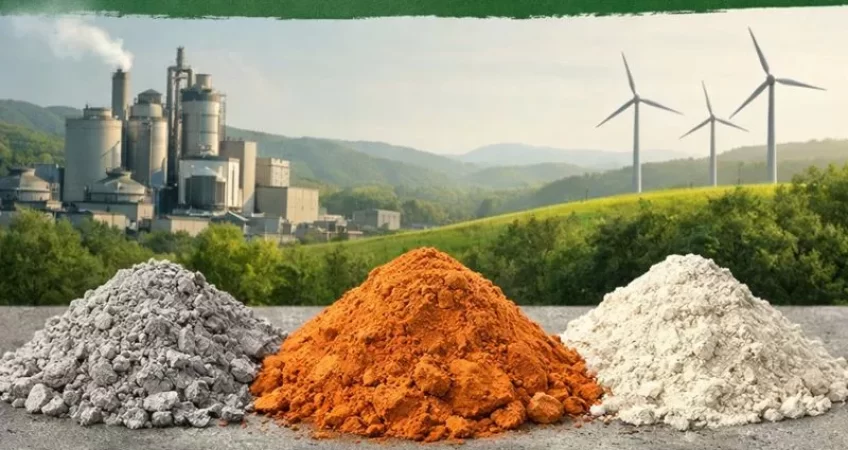
- Color Control: Depending on the specific minerals in the clay, the resulting concrete can have a distinct reddish or off-white hue, offering aesthetic options for architects.
The Industry Veteran: Ground Granulated Blast-Furnace Slag (GGBS)
While calcined clay is gaining rapid momentum, Ground Granulated Blast-Furnace Slag (often referred to simply as slag or GGBS) has been a trusted component in high-performance concrete for years.
Origin and Properties
Slag is a byproduct of the iron and steel industry. Molten iron slag from a blast furnace is rapidly quenched in water or steam to produce a glassy, granular product that is then dried and ground into a fine powder.
Contribution to Low Carbon Cement
Slag is highly cementitious. It can replace a substantial portion of Portland cement—sometimes up to 70% or 80% in specific applications. Because it is a repurposed industrial waste product, its embodied carbon is incredibly low compared to the clinker it replaces.
Concrete containing slag typically sets more slowly, which lowers the heat of hydration. This property is crucial for massive concrete pours, such as dams or thick foundation rafts, where managing thermal cracking is a major engineering challenge. Furthermore, slag-based cement usually results in a lighter, whiter finish, which is highly prized for architectural concrete.
Why Using SCMs Makes Sense: The Benefits
Transitioning to SCM-based cements offers a triple-bottom-line advantage: environmental, technical, and economic.
- Environmental Impact: The math is simple: for every ton of clinker replaced by SCMs, carbon emissions drop almost proportionally. Furthermore, using industrial byproducts like slag prevents these materials from ending up in landfills, promoting a circular economy.
- Enhanced Performance: Engineers do not have to sacrifice strength for sustainability. In fact, SCMs often improve the long-term performance of concrete. They refine the pore structure of the material, making it less permeable to water and aggressive chemicals. This leads to structures that last longer and require less maintenance, which is a sustainability metric in itself.
- Economic Viability: In many regions, SCMs are cheaper than clinker. While there are initial costs associated with modifying batching plants or sourcing new materials, the long-term savings on energy and raw materials—combined with potential carbon tax savings make SCMs a financially sound choice.
Challenges in Adoption and Strategic Solutions
Despite the clear benefits, widespread adoption of SCMs like calcined clay and slag faces hurdles.
Supply Chain Variability: The quality of SCMs can vary depending on the source. Slag quality depends on the specific steel production process, while clay composition changes by region.
- Solution: Rigorous testing and quality control protocols are essential. Companies like TECHCEM Consultancy and Engineering Pvt. Ltd. specialize in helping plants optimize their processes to handle variable inputs effectively.
Regulatory Standards: Construction standards are notoriously slow to change. Many building codes place strict limits on clinker substitution rates.
- Solution: Industry advocacy and the development of performance-based standards (rather than prescriptive ones) allow engineers to use SCMs more freely as long as the concrete meets strength and durability requirements.
Technical Integration: Introducing new materials requires expertise in mix design and plant engineering.
- Solution: Partnering with specialized engineering consultancies ensures that the transition to Low Carbon Cement is smooth, technically sound, and economically optimized.
Real-World Success: SCMs in Action
The viability of SCMs is no longer theoretical; it is visible in skylines around the world.
In major infrastructure projects, such as tunnel linings and bridge pilings, high-volume slag cement is frequently specified to resist sulfate attack and reduce thermal cracking. For instance, the foundations of some of the world’s tallest skyscrapers utilize high-slag mixes to ensure the concrete cures evenly without overheating.
Simultaneously, pilot projects utilizing calcined clay cements are springing up in Europe and India. These projects demonstrate that “green concrete” can be handled, pumped, and finished just like traditional concrete, removing the fear of the unknown for contractors on the ground.
Future Trends in SCM Technology
The Future of Cement lies in multi-component blending. We are moving away from simple binary blends (Cement + Fly Ash) toward ternary and quaternary blends.
- Synergistic Blends: Researchers are finding that combining calcined clay and limestone produces a chemical reaction that boosts strength beyond what the individual materials can achieve alone. This allows for even higher substitution rates.
- Activation Methods: New technologies are emerging to chemically or mechanically “activate” inert materials, potentially turning construction demolition waste into a viable SCM in the future.
- Digital Optimization: AI and machine learning are being used to predict the performance of complex SCM blends, allowing producers to maximize clinker reduction without risking quality.
A Concrete Step Toward Sustainability
The transition to Low Carbon Cement is not a temporary trend; it is a fundamental shift in how we build our world. SCMs, specifically calcined clay and slag, are the backbone of this revolution. They offer a practical, scalable, and effective path to decarbonizing the construction sector.
However, navigating the complexities of material sourcing, plant modification, and quality control requires specialized knowledge. Organizations like TECHCEM Consultancy and Engineering Pvt. Ltd. are instrumental in guiding manufacturers and builders through this transformation. By leveraging expert consultancy and engineering solutions, the industry can fully unlock the potential of SCMs, ensuring that the concrete of tomorrow is as strong as it is sustainable.