Table of Contents
Signed in Lagos in the last few years, this Memorandum of Understanding represents one of Africa’s biggest industrial expansions. Beyond the headline figures, however, there are deeper implications of this agreement for Africa’s economic long-term growth, infrastructure development, employment creation and regional manufacturing.
This article explains what this deal is, what its importance is and how it might affect the construction industry on the continent.
What Exactly Is the $1 Billion Deal?
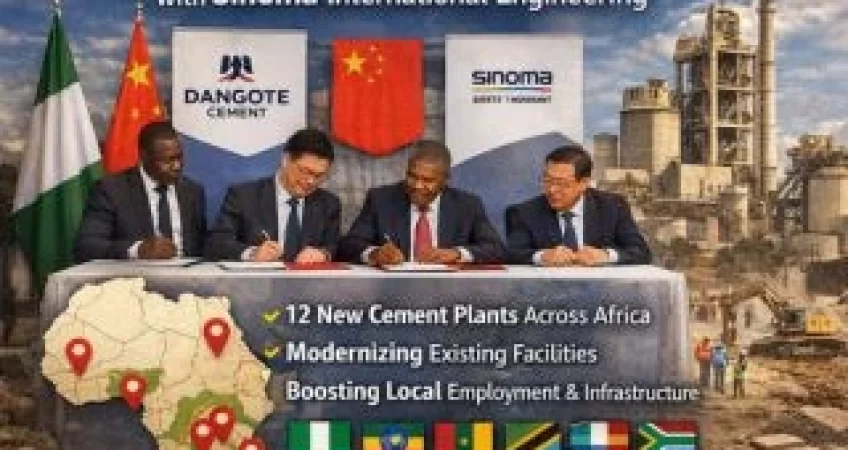
Sinoma International Engineering and Dangote cement have signed an agreement that covers:
-
Construction twelve new cement plants (greenfield project)
-
Expanding and modernizing existing Cement Facilities (brownfield Projects)
-
Installing advanced engineering systems can improve the efficiency of production
Sinoma International Engineering, a global engineering and construction company specializing on cement plant design and infrastructure for industrial applications, is an internationally recognized firm. This partnership is a continuation from a relationship that has already been established. The company previously worked on major projects with Dangote.
This $1 billion investment will increase production in multiple African countries, where Dangote Cement operates.
Why Is Dangote Cement Expanding Now?
Three major factors are behind the aggressive growth strategy.
1. Rising Infrastructure Demand Across Africa
Africa has experienced rapid urbanization. The population is growing and cities are expanding. Governments are also investing heavily in infrastructure, such as:
-
Highways and roads
-
Bridges
-
Housing projects
-
Commercial Buildings
-
Industrial parks
Cement forms the basis of all these construction projects. Cement demand continues to increase as infrastructure development increases. Dangote Cement has positioned itself to meet the demand for cement before any supply gap arises.
2. Strengthening Market Leadership
Dangote Cement has already become the biggest cement manufacturer in Sub-Saharan Africa. The company wants to increase its production and build more plants in order to strengthen their dominance.
The number of plants in different countries is increasing.
-
Transport costs reduced
-
Faster delivery times
-
Greater pricing competitiveness
-
Local markets under tighter control
Local production increases operational efficiency and profitability.
3. Long-Term Strategic Vision
Dangote Cement belongs to the Dangote Group founded by African industrialist Aliko Dangote. The long-term focus of the group is industrialization in Africa.
This cement expansion is in line with the larger ambition to scale production by an impressive amount before 2030. The company will remain competitive in the African market by increasing output.
What Countries Could Benefit?
While specific country allocations may evolve, Dangote Cement already operates in multiple African nations, including:
-
Nigeria
-
Ethiopia
-
Zambia
-
Tanzania
-
Cameroon
-
Senegal
-
South Africa
This expansion will strengthen the operations of some markets, while opening up new business opportunities for others.
Each new plant typically creates:
-
Direct Employment (Engineers, Plant Operators, Technicians)
-
Indirect employment (transportation, logistics, suppliers)
-
Economic Activity in the Surrounding Communities
Investing in this magnitude of industry can often have a positive impact on regional development and not just for cement.
Economic Impact of the Expansion
1. Create a Job
During the construction phase, thousands of people will be needed to complete just 12 new plants. Each plant will have permanent administrative and technical staff once it is operational.
Also, there are ancillary industries such as:
-
Transportation and Logistics
-
Maintenance of Equipment
-
Suppliers of raw materials
-
Local service providers
Increased industrial activity is a great way to benefit.
2. Boost to Local Manufacturing
Africa historically has relied heavily upon imports of industrial goods. By increasing cement production, you can strengthen local manufacturing and decrease your dependency on imported goods.
The local production is improving:
-
Trade balances
-
Foreign exchange reserves
-
Self-sufficiency in the industrial sector
The African Continental Free Trade Area, which is a continental initiative aimed at boosting intra-African commerce, aligns this with the broader goals of initiatives such as AfCFTA.
3. The Cost of Infrastructure Stability
Infrastructure projects are less likely to be delayed by shortages of materials or bottlenecks in imports when the cement supply is local and stable.
To increase production, you may need to:
-
Stabilize cement prices
-
Reducing supply disruptions
-
Build government programs
Access to reliable cement is essential for economies that are growing rapidly.
Why Partner with Sinoma International Engineering?
Sinoma International Engineering has a global reputation for expertise in the design and engineering of cement plants.
Dangote Cement benefits from Sinoma’s partnership:
-
Advance engineering technology
-
Timelines for efficient plant construction
-
Modern Production Systems
-
Proven industrial execution experience
It reduces risk for the project and increases chances of finishing plants within schedule and budget.
This partnership is a reflection of the trust between both organizations and their technical alignment.
Strategic Positioning for 2030
Dangote Cement is aiming for ambitious growth in the coming decade. To achieve these goals, it is vital to increase the total production capacity.
Africa is expected to have a significant population increase by 2030. Urban centers are also projected to expand rapidly. The demand for infrastructure is also expected to rise. Early investments in capacity will help companies capture market shares over the long term.
The commitment of $1 billion signals confidence in Africa’s future economic growth.
Potential Challenges
Large-scale industrial expansions are not without risk, even though they may be promising.
-
Currency fluctuation
-
Instability in some regions due to political instability
-
Approvals – Regulatory
-
Constraints on energy supply
-
Global economic volatility
Dangote Cement has the institutional expertise to help navigate through these challenges.
What This Means for Africa’s Cement Industry
This agreement confirms a larger trend. Africa is slowly shifting away from importing goods and towards domestic production.
The project can:
-
Raising the standard of competitiveness in the cement sector
-
Foreign direct investments should be encouraged
-
Regional supply chains:
-
Strengthen Africa’s industrial base
In response, competitors may accelerate their expansion plans.
Final Thoughts
This $1 billion deal between Dangote Cement Plc and Sinoma International Engineering goes beyond a simple corporate expansion. This agreement represents an important step in strengthening Africa’s infrastructure and industrial ecosystem.
Dangote Cement, by building new plants and expanding its existing ones, is strengthening its position on the continent, preparing it for future demands, as well as enhancing its presence in the market.
The move is a sign of growing confidence in Africa’s industrial sector and economic growth.
This expansion, if it continues to grow at the current rate, could have a major impact on the construction and manufacturing landscape of the continent in the coming decade.