
Table of Contents
Decarbonizing Cement: 3 Technologies Changing the Industry
Concrete is the second most consumed substance on Earth, surpassed only by water. It is the literal foundation of modern civilization, building our bridges, homes, and skyscrapers. However, this ubiquity comes at a significant environmental cost. The Cement Manufacturing Industry is responsible for roughly 7-8% of global carbon dioxide emissions, presenting a massive challenge for climate goals.
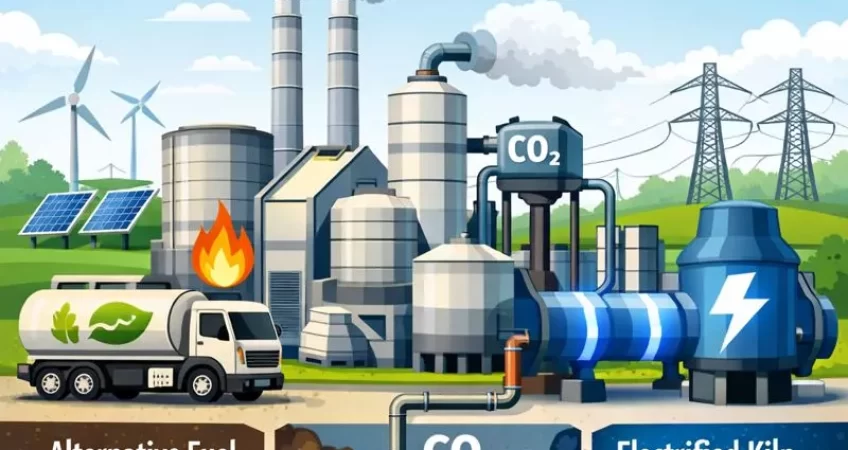
The traditional process of heating limestone and clay to 1450°C requires immense amounts of energy, typically derived from coal or petcoke. But the industry is not standing still. A wave of innovation is transforming how we think about this essential material. At TECHCEM Consultancy and Engineering Pvt. Ltd., we are closely monitoring the shift toward sustainable production methods. Specifically, three technologies are emerging as frontrunners in the race to net-zero: alternative fuels, Carbon Capture, Utilization, and Storage (CCUS), and electrified kilns.
The Shift to Alternative Fuels
For decades, the cement kiln was synonymous with coal combustion. Today, the industry is rapidly transitioning toward co-processing, where waste materials replace primary fossil fuels.
Turning Waste into Energy
Alternative fuels (AF) encompass a broad range of materials that would otherwise end up in landfills or incinerators. This includes:
- Refuse-Derived Fuel (RDF): Processed municipal solid waste.
- Biomass: Agricultural waste like rice husks or nut shells.
- End-of-life tires: Used tires provide high calorific value.
- Industrial solvents: Waste oils and fluids.
Benefits and Challenges
The primary advantage here is twofold: it reduces reliance on non-renewable fossil fuels and offers a safe disposal method for waste materials. Because cement kilns operate at extremely high temperatures, they ensure the complete destruction of harmful compounds found in waste.
However, implementation isn’t as simple as tossing trash into a burner. Different fuels burn at different rates and temperatures, which can destabilize the kiln process if not carefully managed. Pre-processing facilities and advanced feeding systems are often required to ensure a consistent fuel mix that maintains clinker quality.
Tackling Process Emissions with CCUS
While alternative fuels address the energy source, they don’t solve the chemistry problem. A significant portion of cement emissions comes from “process emissions” the chemical reaction that occurs when limestone (calcium carbonate) is heated and releases CO2 to become lime (calcium oxide). Even if a kiln ran on 100% clean energy, these emissions would persist.
- Capturing the Carbon: This is where Carbon Capture, Utilization, and Storage (CCUS) becomes essential. CCUS technologies capture carbon dioxide from flue gases before they enter the atmosphere. Once captured, the CO2 is compressed and transported for permanent storage in geological formations or utilized in other industrial processes, such as making synthetic fuels or curing concrete.
- The Road Ahead for CCUS: Several high-profile pilot projects are currently underway globally, aiming to prove the economic viability of capturing carbon at a Cement Plant scale. While the technology is proven, the challenge remains the high cost of capture and the infrastructure required for transport and storage. Despite the hurdles, CCUS is widely regarded as non-negotiable for achieving a truly carbon-neutral cement industry.
The Electrified Kiln Revolution
Perhaps the most futuristic of the three technologies is the electrified kiln. If the goal is to stop burning things to generate heat, electricity offers a compelling answer.
- How It Works: Traditional kilns use a flame to heat the raw materials. An electrified kiln replaces that flame with electric heating elements or plasma generators. If the electricity powering the kiln comes from renewable sources like wind, solar, or hydro, the thermal energy input becomes carbon-free.
- Transforming Production: This technology is currently in the pilot and research phases, with several European consortiums testing the feasibility of electric cement production. The potential impact is profound. By eliminating combustion, electrified kilns not only remove fuel-based CO2 emissions but also allow for a purer stream of CO2 from the limestone calcination process. This makes the carbon capture process (mentioned above) significantly cheaper and more efficient because the gas doesn’t need to be separated from combustion pollutants.
Building a Greener Foundation
The path to sustainable construction is complex, requiring a mix of incremental improvements and radical innovations. Alternative fuels are an immediate, effective step for reducing fossil fuel reliance today. CCUS offers a necessary solution for unavoidable process emissions, while electrified kilns represent a bold vision for a combustion-free future.
The future of Cement Manufacturing depends on how quickly and effectively these technologies can be scaled. With industry leaders and engineering experts like TECHCEM Consultancy and Engineering Pvt. Ltd. navigating these changes, the prospect of green concrete is moving from theory to reality.