
Table of Contents
In Cement Production, achieving maximum mill output while maintaining precise fineness control is a constant challenge. The key to unlocking this efficiency lies in the heart of the grinding circuit the High Efficiency Classifier. At TECHCEM Consultancy and Engineering Pvt. Ltd., a leading engineering firm based in Mumbai, we specialize in optimizing these systems to elevate your plant’s performance.
A well-designed classifier is not just a piece of equipment, it’s the central component that dictates the productivity and quality of your final product. By effectively separating fine particles from coarse ones, it prevents over-grinding, reduces energy consumption, and ensures your cement meets exact specifications. This guide explores the critical aspects of high-efficiency classifier design and how to leverage it for unparalleled results.
Why Choose TECHCEM for Your High Efficiency Classifier Needs?
As a trusted partner in the Cement Industry, TECHCEM offers unmatched expertise and innovative solutions. Our unique strengths include:
- Customized Design: We don’t believe in one-size-fits-all. Our solutions are tailored to your specific raw materials, existing mill setup, and production goals.
- Advanced Simulation: We use cutting-edge computational fluid dynamics (CFD) and other simulation tools to model and perfect classifier performance before implementation.
- End-to-End Support: From initial audit and design to commissioning and post-installation support, our Mumbai-based team provides comprehensive project management.
- Proven Results: Our projects consistently deliver measurable improvements in mill output, energy savings, and product quality for clients across India and beyond.
- Deep Industry Knowledge: With decades of combined experience, our engineers understand the unique challenges faced by Cement Plants in diverse operational environments.
Understanding High Efficiency Classifier Design and Performance
To select the best design, it’s essential to understand the core principles and components that drive classifier efficiency.
What is a High Efficiency Classifier?
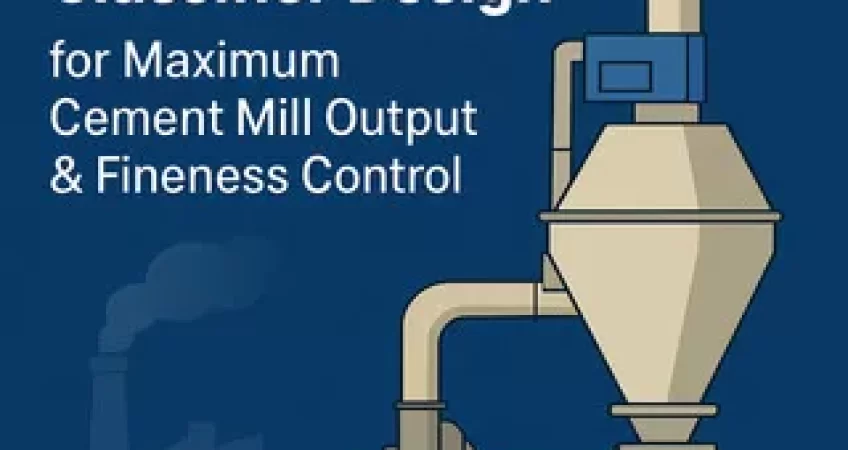
A high-efficiency classifier is a mechanical device used in a closed-circuit grinding system to separate finely ground material from coarse material. The coarse material, or “rejects,” is sent back to the mill for further grinding, while the fine material, or “product,” is collected. The primary goal is to make this separation as sharp and precise as possible.
Modern classifiers, often called “third-generation” or “fourth-generation” classifiers, use a combination of aerodynamic principles and mechanical rotation to achieve superior performance compared to older static or first-generation dynamic separators.
Key Components of a Modern Classifier
A typical high-efficiency dynamic classifier consists of several critical parts working in tandem:
- Rotor Cage: This is the heart of the classifier. The rotating cage creates a centrifugal force that pushes coarser particles to the outside, while finer particles are drawn inward by the airflow. The speed of the rotor is a primary control for product fineness.
- Guide Vanes: These stationary vanes control the airflow into the separation zone, creating a vortex that helps pre-separate material and ensures a uniform flow pattern.
- Airlocks and Sealing: Proper sealing is crucial to prevent “false air” from entering the system, which can disrupt the classification process and reduce efficiency.
- Distribution Plate: This component ensures that the feed material is evenly distributed into the separation zone, preventing particle agglomeration and improving separation accuracy.
Optimizing for Maximum Output and Fineness Control
Achieving peak performance involves a delicate balance of operational parameters and design choices.
How Does Classifier Design Impact Mill Output?
An efficient classifier directly increases mill output by preventing over-grinding. When fine particles are quickly removed from the grinding circuit, the mill can focus its energy on breaking down only the coarse particles. This results in:
- Higher Throughput: The mill can process more material per hour because it isn’t wasting energy on already-fine particles.
- Lower Specific Energy Consumption: Less energy is needed to produce a ton of cement, leading to significant cost savings.
- Improved Grinding Media Efficiency: The grinding balls or media work more effectively on a bed of coarser material.
For example, a cement plant in the Satna cluster, Madhya Pradesh, upgraded its classifier and saw a 15% increase in mill output and a corresponding drop in power consumption, showcasing the direct impact of efficient classification.
How to Achieve Precise Fineness Control
Fineness, often measured in Blaine or as residue on a specific sieve (e.g., 45 microns), is critical for cement quality. A high-efficiency classifier provides several levers for precise control:
- Rotor Speed (RPM): This is the most direct control. Increasing the rotor speed makes the product finer by rejecting more particles, while decreasing the speed makes it coarser.
- Airflow Volume: Adjusting the fan damper changes the volume of air passing through the classifier. Higher airflow can carry more fine particles, influencing the cut point.
- Guide Vane Angle: Modifying the angle of the guide vanes alters the swirl of the airflow, affecting the separation sharpness.
Best Practices for Classifier Operation
To maintain optimal performance, follow these actionable tips:
- Regular Audits: Conduct periodic performance audits to check for wear and tear, air leakages, and operational deviations.
- Monitor Key Parameters: Continuously track rotor speed, fan damper position, classifier pressure drop, and motor power consumption.
- Maintain Stable Feed: Ensure a consistent feed rate and chemistry to the mill, as fluctuations can destabilize the classifier’s performance.
- Calibrate Instruments: Regularly calibrate all measuring instruments, such as pressure transmitters and speed sensors, for accurate control.
- Optimize Airflow: Ensure the ducting design is smooth and free of sharp bends to minimize pressure drops and maintain efficient airflow.
Common Mistakes and Challenges to Avoid
Even the best classifier design can underperform if not operated correctly. Watch out for these common pitfalls:
- Internal Air Leakages: Worn seals can allow coarse particles to bypass the separation zone and contaminate the final product.
- Ignoring Material Buildup: Material can build up on the rotor blades and guide vanes, disrupting airflow and reducing efficiency.
- Running with High Circulating Load: Excessively high circulating loads can overwhelm the classifier, leading to poor separation.
- Incorrect Fan Sizing: An undersized or oversized fan can lead to inefficient airflow and an inability to achieve the desired fineness.
TECHCEM’s Expertise in Action
TECHCEM has a long history of successful projects involving high-efficiency classifiers. Our team has worked on everything from greenfield projects to complex retrofits for major Cement Producers in India and abroad. We hold certifications and adhere to international standards, ensuring our engineering solutions are both reliable and innovative. Our hands-on experience allows us to diagnose issues quickly and implement effective, data-driven solutions that deliver tangible returns on investment.
Frequently Asked Questions (FAQs)
What is the bypass in a high-efficiency classifier?
Bypass refers to the fraction of feed material that goes directly into the fine product without being properly classified. Minimizing bypass is key to achieving sharp separation.
How do I know if my classifier is inefficient?
Signs of inefficiency include high specific energy consumption, difficulty in achieving target fineness, and a wide particle size distribution in the final product.
Can an old cement mill be upgraded with a new classifier?
Yes, retrofitting an older mill with a modern high-efficiency classifier is a common and highly effective way to boost its performance and extend its operational life.
Elevate Your Production with TECHCEM
The right high-efficiency classifier design is fundamental to maximizing cement mill output and ensuring precise fineness control. By focusing on customized design, advanced simulation, and operational best practices, your plant can achieve new levels of productivity and profitability.
Ready to optimize your grinding circuit? Contact TECHCEM Consultancy and Engineering Pvt. Ltd. today to discuss how our expert solutions can transform your cement production process.