
Table of Contents
Cement manufacturing requires precise crushing of raw materials to achieve optimal particle size for grinding. Choosing the right Crusher is crucial to ensure efficiency, reduce energy consumption, and improve the overall quality of cement. Among the commonly used crushers impact, hammer, jaw, and roller crushers each has its unique advantages and ideal applications.
Jaw Crusher – The Heavy-Duty Workhorse
Jaw crushers are widely used in cement plants for primary crushing of hard and abrasive raw materials like limestone and clinker. They operate using compressive force: the material is fed into a V-shaped chamber where a moving jaw presses it against a fixed jaw.
Advantages:
- High crushing efficiency for hard and tough materials
- Simple structure, easy maintenance
- Stable performance and long service life
Limitations:
- Produces a relatively coarse output
- Less suitable for soft or sticky materials
Jaw crushers are ideal for primary crushing and are typically used at the start of the cement production process.
Impact Crusher – Efficient for Medium-Sized Material
Impact crushers break materials by using impact force. When materials enter the crusher, they are struck by high-speed rotating hammers or blow bars.
Advantages:
- Produces finer and uniform particle sizes
- High crushing ratio
- Effective for brittle or medium-hard materials
Limitations:
- Not ideal for extremely hard materials like basalt
- Wear parts require frequent replacement
Impact crushers are suitable for secondary crushing, especially when the goal is to achieve a uniform particle size for further grinding.
Hammer Crusher – High Reduction Ratio
Hammer crushers are designed for medium to soft materials and work on the principle of repeated impact. The hammer rotates at high speed, impacting materials to crush them.
Advantages:
- High crushing ratio
- Suitable for soft and medium-hard materials
- Simple design and easy maintenance
Limitations:
- Not suitable for very hard or abrasive materials
- Produces more fines, which may affect downstream processes
Hammer crushers are commonly used for raw materials like limestone in cement plants where large particle reduction is required.
Roller Crusher – For Uniform Particle Size
Roller crushers utilize compression and shear forces to crush materials between two rotating rollers. They are mainly used for fine crushing in cement plants.
Advantages:
- Produces uniform particle size
- Low energy consumption
- Minimal dust generation
Limitations:
- Not suitable for very hard or abrasive materials
- Limited capacity compared to jaw or impact crushers
Roller crushers are ideal for secondary and tertiary crushing stages, ensuring consistent material size for grinding.
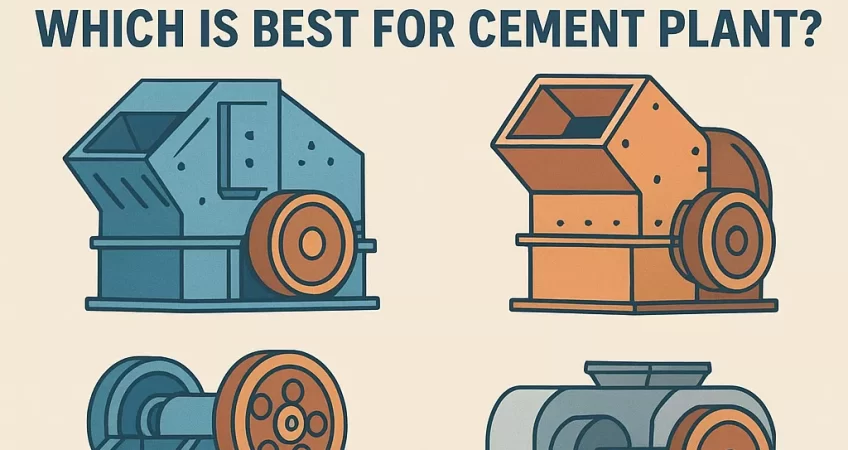
Which Crusher is Best for Cement Plants?
The choice of crusher largely depends on the raw material type, required particle size, and stage of crushing:
- Jaw Crusher – Best for primary crushing of hard materials.
- Impact Crusher – Suitable for medium-hard materials and achieving uniform particle size.
- Hammer Crusher – Effective for soft to medium-hard materials needing high reduction.
- Roller Crusher – Ideal for fine crushing and uniform particle size before grinding.
In many cement plants, a combination of crushers is used to optimize efficiency: jaw crushers for primary crushing, followed by hammer or impact crushers for secondary crushing, and roller crushers for fine crushing. This integrated approach ensures maximum productivity, energy efficiency, and consistent material quality.
TECHCEM Consultancy and Engineering Pvt. Ltd. is a leading provider of engineering solutions for the cement industry. With years of expertise, TECHCEM helps plants optimize performance, reduce operational costs, and implement modern technologies for sustainable and efficient cement production.