
Table of Contents
Building a cement plant is a monumental undertaking. It requires significant capital investment, complex technology, and rigorous regulatory compliance. Whether you are a seasoned industrialist or a new entrant in the manufacturing sector, the bridge between your vision and the necessary funding is a document known as a Detailed Project Report (DPR).
However, not just any report will do. To secure financing from banks and financial institutions, you need a “Bankable” DPR. This document serves as the blueprint for your entire project, offering lenders the confidence that your venture is viable, profitable, and safe.
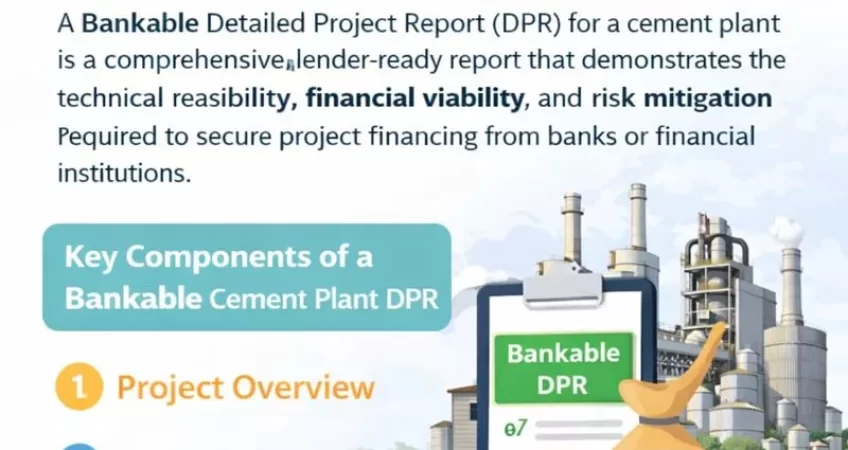
A Bankable DPR goes beyond basic descriptions. It is a lender-ready, comprehensive analysis that proves the technical feasibility, financial health, and risk mitigation strategies of your proposed cement plant. It answers the hard questions before the bank even asks them.
Understanding the “Bankable” DPR
In the context of industrial financing, “bankable” means that a project is robust enough to warrant a loan. A Bankable DPR is structured specifically to meet the strict due diligence standards of financial institutions.
While a standard feasibility study might tell you if a project is possible, a Bankable DPR tells a lender that the project is a safe bet. It demonstrates that you have secured raw materials, validated the market demand, chosen the right technology, and most importantly calculated exactly how and when the loan will be repaid.
Key Components of a Bankable DPR
A robust report covers every aspect of the project lifecycle. While the specific requirements may vary slightly depending on the lending institution, the core pillars remain the same. A truly comprehensive report integrates technical data with financial forecasts to create a holistic view of the business.
The primary sections include technical feasibility, market assessment, financial analysis, regulatory compliance, and risk management. Let’s explore why each of these is critical for cement plants.
Technical Feasibility and Viability
The technical section is the foundation of your report. If the plant cannot physically operate efficiently, the financials are irrelevant. For a cement plant, this section must address several specific factors:
- Raw Material Availability: Cement manufacturing is resource-intensive. The DPR must prove that you have long-term access to limestone, clay, gypsum, and other additives. Lenders require geological surveys and mining leases that guarantee raw material supply for the lifespan of the plant (often 20 to 50 years).
- Location and Logistics: Where will the plant be built? The report must analyze the site’s proximity to limestone deposits (to minimize transport costs) and the target market. It should also detail logistics: road access, railway sidings, and power supply availability.
- Technology Selection: Banks prefer proven technology over experimental methods. Your DPR should detail the manufacturing process typically the dry process with pre-calciner technology for modern plants due to its energy efficiency. It should list key equipment like crushers, raw mills, rotary kilns and cement mills, explaining why specific machinery was chosen.
Financial Projections and Analysis
This is the section lenders scrutinize the most. They need to see a clear path to profitability. A bankable report transforms technical data into monetary values.
Capital Cost (CAPEX)
This includes the total cost of land, plant and machinery, civil works, pre-operative expenses and working capital margin. The estimates must be realistic and backed by vendor quotations.
Operating Cost (OPEX)
This details the day-to-day costs of running the plant, including power and fuel (coal/petcoke), raw materials, manpower and maintenance.
Key Financial Ratios
To prove viability, the DPR must present projected cash flows for the next 7 to 10 years. Crucial metrics include:
- Internal Rate of Return (IRR): Indicates the profitability of the investment.
- Net Present Value (NPV): Shows the value of future cash flows today.
- Debt Service Coverage Ratio (DSCR): This is vital for banks. It measures your cash flow available to pay current debt obligations. A healthy DSCR assures the bank you can make your monthly payments.
Market Assessment and Demand Analysis
You can build the most efficient plant in the world, but it will fail if no one buys the cement. The market assessment section proves that there is a hunger for your product.
This section should provide a detailed analysis of the supply-demand gap in your target region. It should cover:
- Macro Drivers: Infrastructure projects, housing schemes, and urbanization trends driving cement consumption.
- Competitor Analysis: Who else is selling in the region? What is their market share and pricing strategy?
- Marketing Strategy: How will you penetrate the market? Will you focus on trade sales (retail) or non-trade sales (bulk supply to big projects)?
Regulatory and Environmental Compliance
The cement industry is heavily regulated due to its environmental impact. A Bankable DPR must demonstrate that the project is legally sound and environmentally responsible.
Lenders are increasingly focused on Environmental, Social, and Governance (ESG) criteria. The report must detail:
- Clearances: Status of environmental clearance, forest clearance (if applicable), and consent to establish from pollution control boards.
- Sustainability: Measures taken to reduce the carbon footprint, such as waste heat recovery systems (WHRS) or the use of alternative fuels.
- Social Impact: Plans for Corporate Social Responsibility (CSR) and how the plant will impact the local community.
Risk Assessment and Mitigation Strategies
Every project carries risk. A Bankable DPR does not hide these risks; it identifies them and offers solutions. This transparency builds trust with lenders.
Common risks in cement projects include:
- Fluctuating Fuel Prices: Coal and petcoke prices are volatile. Mitigation might include long-term fuel supply agreements or the ability to switch fuel types.
- Project Delays: Delays in construction increase costs. Mitigation involves hiring experienced EPC (Engineering, Procurement, and Construction) contractors with penalty clauses for delays.
- Market Risk: If demand drops, how will the plant survive? Sensitivity analysis helps here, showing that the project remains viable even if sales drop by a certain percentage.
The Importance of a Robust DPR
A Bankable DPR is more than a requirement for a loan application; it is a strategic tool for the business owner. It forces you to validate every assumption, stress-test your business model and plan for contingencies.
For cement plants, where the initial investment is massive and the payback period is long, a well-crafted DPR is the difference between a stalled project and a successful, funded enterprise. It aligns the vision of the entrepreneur with the safety requirements of the banker, ensuring that when the first bag of cement rolls off the line, the financial foundation is as strong as the product itself.
TECHCEM Consultancy and Engineering Pvt. Ltd. specializes in preparing bankable Detailed Project Reports (DPRs) for cement plants, bridging the gap between industrial vision and financial approval. With deep domain expertise in cement manufacturing, project engineering, and industrial finance, TECHCEM delivers lender-ready DPRs that meet the stringent due diligence standards of banks and financial institutions. Our reports integrate technical feasibility, accurate financial modeling, regulatory compliance and comprehensive risk assessment giving project promoters and lenders the confidence needed to move from concept to commissioning with clarity and certainty.