
Table of Contents
In the heavy industrial sectors of mining and cement production, energy efficiency isn’t just a buzzword it’s the primary driver of profitability. Comminution, the process of reducing particle size, accounts for a massive portion of the total energy consumed in these industries. As operators look to reduce cement production costs and improve sustainability, the limitations of traditional milling are becoming apparent.
Enter the Hybrid Grinding Circuit. This innovative approach is reshaping how we think about the comminution process. By moving away from single-stage reliance and integrating multiple technologies, plants can achieve higher throughput and better product quality with significantly lower energy usage.
At TECHCEM Consultancy and Engineering Pvt. Ltd., we understand that selecting the right grinding technology is critical. This guide explores the mechanics, benefits, and components of hybrid systems and why they are quickly becoming the industry standard for new and retrofitted plants.
Understanding Traditional Hybrid Grinding Circuit
For decades, the standard cement grinding unit relied heavily on the ball mill circuit. A ball mill is a robust piece of equipment, consisting of a rotating cylinder filled with steel balls. As the cylinder rotates, the balls drop onto the material, crushing it into a fine powder.
While reliable, traditional ball mills have significant drawbacks. They are notoriously energy-inefficient, with a high Specific power consumption (SPC) in grinding. Much of the energy input is lost as heat and noise rather than being used for actual size reduction. Furthermore, they struggle with clinker grindability variations; if the feed material becomes harder, the mill’s throughput drops drastically, disrupting the entire production line. To optimize ball mill energy consumption, the industry had to look for a partner technology that could handle the heavy lifting before the material even entered the ball mill.
What is a Hybrid Grinding Circuit?
A hybrid grinding system is a configuration that combines a high-efficiency pre-grinding device typically a High pressure grinding roll (HPGR) circuit or a roller press with a conventional ball mill.
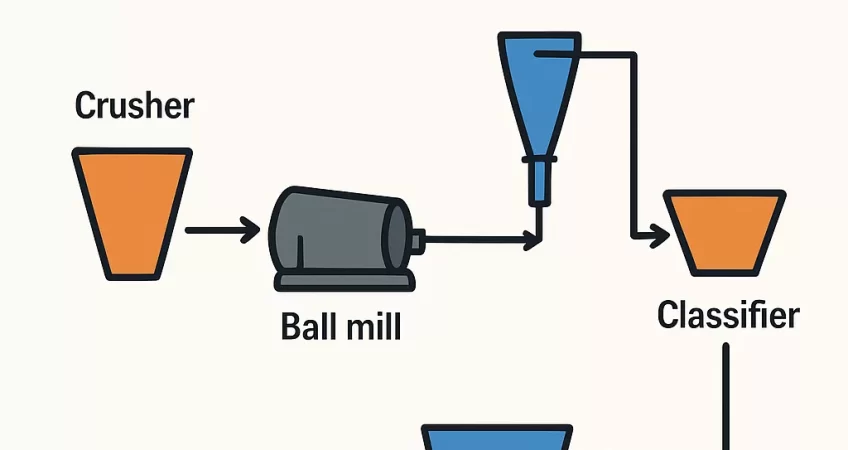
Unlike a simple combi grinding circuit technology, where material passes through a roller press and goes directly to the ball mill, a hybrid circuit introduces a separation step. In a hybrid setup, the material exiting the roller press is sent to a separator or classifier. The fine material that meets the quality specs bypasses the ball mill entirely, while only the coarse material is sent to the ball mill for final grinding.
This setup creates a closed circuit grinding system that ensures the ball mill only expends energy on particles that actually need it. This distinction is vital when discussing the difference between combi and hybrid grinding; the hybrid system offers superior efficiency by preventing over-grinding.
Components and Technologies Used in Hybrid Grinding Circuit
The success of a hybrid circuit lies in the integration of specific, high-performance machinery.
- Roller Press Grinding: The core of the system is usually roller press grinding. Here, two counter-rotating rolls crush the material under immense pressure. This doesn’t just reduce the size; it creates micro-cracks in the particles, significantly improving the grindability of the material before it hits the next stage.
- Roller Press with Ball Mill Circuit: By combining a roller press with ball mill circuit, you get the best of both worlds. The roller press acts as a pre-grinding system for cement, dealing with the coarse feed efficiently. The ball mill then performs thefinish grinding with roller press product, ensuring the final cement has the correct texture and strength properties.
- Separation Technology: To achieve a hybrid cement mill optimization, separation is key. A high efficiency separator is used to split the material streams. Additionally, a trommel screen for mill circuit protection may be installed to prevent tramp metal or oversized scats from damaging the machinery.
Advantages of Hybrid Grinding Circuit
Why are operators upgrading to these complex systems? The advantages of hybrid grinding over ball mill standalone units are quantifiable and significant.
- Enhanced Energy Efficiency: The most immediate impact is on the energy bill. Because the roller press is much more efficient at crushing than a ball mill, the overall system uses less power. Facilities often report a significantly lower kWh per ton cement produced.
- Improved Throughput: With the roller press handling the initial size reduction, the ball mill is relieved of a significant load. This allows for mill output maximization, enabling plants to increase cement mill throughput without buying a larger ball mill.
- Better Product Quality: Cement quality depends heavily on the Cement particle size distribution (PSD). A hybrid circuit allows for precise control over this distribution. The ball mill is excellent at broadening the PSD (which helps with concrete workability), while the high-efficiency separator ensures no coarse particles slip through.
- Operational Flexibility: Hybrid circuits can adapt to changes in feed material. If the clinker becomes harder to grind, the pressure on the roller press can be adjusted, minimizing the impact on the final production rate.
Hybrid Grinding vs VRM (Vertical Roller Mill)
A common question in the industry is how this compares to other technologies: Hybrid grinding vs VRM (Vertical Roller Mill).
While VRMs are highly efficient drying-grinding units, they can be sensitive to mechanical vibrations and require high maintenance. A hybrid circuit retains the reliability and familiarity of the ball mill while approaching the energy efficiency of a VRM. For many existing plants, converting to a hybrid system is more feasible than installing a completely new VRM tower.
Design and Implementation Considerations
Implementing these systems requires careful planning. TECHCEM Consultancy and Engineering Pvt. Ltd. specializes in evaluating existing infrastructure to determine the best integration strategy.
Key design factors include:
- Material Characteristics: Understanding the abrasiveness and moisture content of the feed.
- Space Constraints: Retrofitting often requires fitting new equipment into tight spaces.
- Control Systems: Advanced automation is required to balance the load between the roller press and the ball mill.
Future Trends in Grinding Technology
As we look ahead, the question of how to improve cement mill efficiency? will likely be answered by digital technologies. We are moving toward AI-driven control systems that predict grindability changes and adjust hydraulic pressures in real-time.
Furthermore, benefits of roller press in cement industry applications are expanding. We are seeing larger, more durable rolls capable of handling higher pressures, further reducing the reliance on the tumbling action of ball mills.
The shift toward hybrid grinding circuits represents a mature, proven step forward for the mining and cement industries. By combining the high-pressure efficiency of roller presses with the reliability and product quality control of ball mills, operators can achieve massive gains in productivity and sustainability.
Whether you are looking to lower your specific power consumption or increase your plant’s capacity, the hybrid approach offers a flexible and cost-effective solution.
Ready to optimize your grinding operations? Contact TECHCEM Consultancy and Engineering Pvt. Ltd. today to discuss how we can engineer a solution tailored to your production goals.