
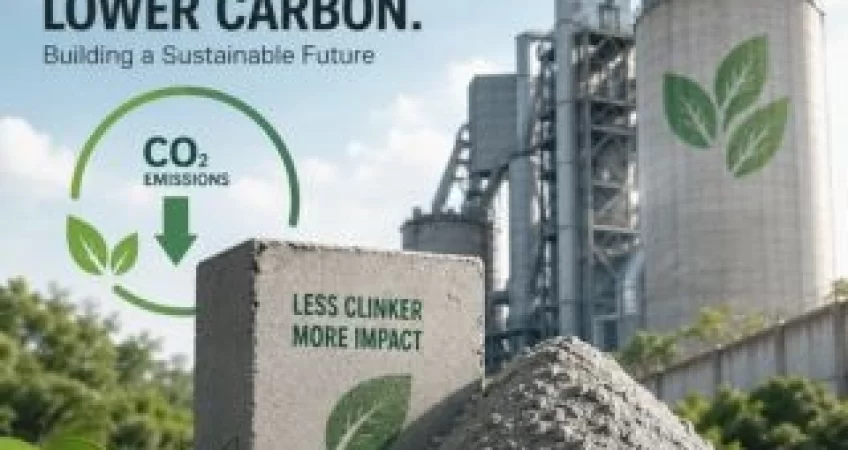
The industry of cement is at the point of turning in which sustainability is no longer an option, it’s now a requirement. The demand for construction in the world increases as does the pressure to lower carbon emissions to cement. Of the many options available to you, one standouts due to its ease of use and instant impact by reducing the clinker effect.
It is often overlooked that the clinker factor can be an essential metric which directly impacts cement’s carbon footprint. If we rethink the amount of clinker that gets into cement, industry could discover one of the largest potential decarbonization strategies without waiting for revolutionary technologies.
Why Cement Deweeecarbonization Matters
The Scale of Cement’s Carbon Footprint
Cement is the basis of our modern infrastructure. Yet, it has a substantial environmental price. From bridges and roads to commercial and residential buildings, the demand for cement continues to grow globally, especially in the fast-growing economies. However, this growth poses a major challenge. the cement industry accounts for a significant portion of carbon dioxide emissions worldwide.
Most of the emissions are a result of the manufacture of clinker which is the main bonding component of cement. With climate goals becoming more stringent and government pushes for net-zero commitments, pressure on cement producers to reduce carbon emissions has increased. In the midst of all options reduction of the clinker effect is one of the fastest and successful solutions.
What Is the Clinker Factor?
The clinker percentage refers to the amount of clinker that is used in the cement that is produced. For the case of traditional Ordinary Portland Cement (OPC) the proportion is usually quite high, and often exceeds 90 percentage. Although clinker offers strength and longevity, it’s the carbon-intensive element used in the production of cement.
The emissions produced by the manufacturing of clinker are a result of two major sources. One is the calcination process which is where limestone (calcium carbonate) is heated, and then releases CO2 while it transforms into lime. The second is the burning of fossil fuels that are required in kilns that are heated to extremely high temperatures, typically over 1400°C. In combination, these two steps result in clinker production being the main cause of carbon emissions throughout the lifecycle of cement.
The Clinker Problem: Why It Needs Fixing
Environmental and Economic Impact
Reduced clinker usage isn’t just environmental-friendly, but also economically sense. A high clinker use rate means greater usage of energy, a greater dependency of raw materials such as limestone, as well as a higher the risk of carbon pricing which are in use in a number of areas.
In terms of environmental impact from a sustainability perspective, the reliance on cement with high clinker content isn’t sustainable. When the demand for infrastructure increases the emissions are expected to increase unless changes are made to the way we use cement. In terms of economics, the rising cost of fuel as well as carbon taxation have already impacted profits, causing producers to think of alternative strategies.
The Solution: Reducing the Clinker Factor
The reduction of the clinker effect requires replacing clinker partially with other materials referred to as supplementary cementitious substances (SCMs). These substances can boost the performance of cement or keep it in good condition and significantly reduce the carbon footprint.
The most common SCMs are industrial by-products such as fly ash and Slag, and organic materials like limestone and calcined clay. Through optimizing the composition of cement makers can produce mixed cements with similar strength and endurance, but while emitting less.
LC3 Cement: A Game-Changer
A number of intriguing developments in this area can be Limestone Calcined Clay Cement (LC3). In contrast to traditional blends which rely extensively on waste industrial, LC3 uses abundant and readily available resources, including limestone and clay of low quality.
The use of LC3 reduces the amount of clinker by as much as 50%, without impacting efficiency. Also, it needs less calcination temperature to process clay, which can further cut down on energy usage. This is what makes LC3 not only sustainable for the environment but also viable economically, particularly in areas that have slag and fly ash are scarce.
Benefits of Tackling the Clinker Factor
Reduced clinker production yields many benefits for business and the environment which extend beyond mere reductions in emissions. This aligns with sustainable development goals across the globe while providing significant operational benefits for manufacturing.
- Significant decrease in the CO2 emissions (up up to 30%-40 percent)
- Lower energy consumption during production
- Reduction in dependence on the scarcity of material sources
- Cost savings over the long-term
- A better aligning to ESG and the regulatory regulations
The benefits of clinker reduction make it an extremely effective and adaptable solutions in companies in.
Challenges and Industry Barriers
However, despite its promise, the use of cement with low clinker is not without its challenges. One of the biggest obstacles is the strict nature of the construction sector, which is where reliability of performance is crucial and the pace of change can be very slow. Building and engineering professionals prefer to use proven products, which makes it challenging for novel formulations to get quick acceptance.
Furthermore, the outdated guidelines and rules in a few regions continue to favor traditional cement blends. This restricts the capability of companies to experiment with new ideas. The constraints of supply chain and the inadvertence are also factors in slowing the process of adoption, especially in emerging markets.
The Road Ahead: Scaling Low-Clinker Cement
What Needs to Happen Next
To realize the full benefits of reduction in clinker factors, coordination is required throughout every step of value chain. It is essential for policymakers to revise standards in order to allow mixed cements. Industry players should put money into the research and development of production capacities and education initiatives.
Education plays a vital part in establishing trust between all stakeholders. The demonstration of the performance over time and dependability of cement with low clinker is vital to ensure its widespread use. In the meantime working together between government agencies manufacturing companies, construction companies can speed up the process of transition.
Turning low-hanging fruit into Impactful
A clinker crunch offers one of the best options for decarbonizing in the world of cement. In contrast to new technologies that require many years of research and developing, the strategies to reduce clinker are proven and can be scaled.
In embracing strategies such as LC3 and other mixed cements and other blended cements, the construction industry will be able to immediately make progress toward sustainable goals. It is easy to follow the path to reduce the amount of clinker used, decrease emissions, and develop an environmentally sustainable future for construction.
Need expert help with this? See how TECHCEM’s process engineering services can support your project.