
Table of Contents
In the cement and mining industries, the choice of grinding technology determines profitability, energy efficiency, and product quality. Selecting the right equipment is not merely a purchasing decision; it is a long-term strategic move. Whether you are setting up a greenfield project or upgrading an existing plant, understanding the nuances between a Ball Mill, a Vertical Roller Mill (VRM) and a Rollerpress is critical.
At TECHCEM Consultancy and Engineering Pvt. Ltd., based in the heart of Mumbai, India, we specialize in guiding industrial players through these complex engineering decisions. Through our expert cement plant consultancy services, we help clients select the right grinding technology suited to their plant capacity, raw material characteristics, and long-term production goals. This comprehensive guide breaks down the operational differences, benefits and best applications for these three grinding giants.
Why Partner with TECHCEM?
Before diving into the technical comparison, here is why industry leaders across India trust TECHCEM for their engineering needs:
- Localized Expertise: Deep understanding of the Indian market and regulatory landscape from our Mumbai headquarters.
- Holistic Engineering: We don’t just supply advice; we provide end-to-end consultancy from concept to commissioning.
- Cost Optimization: Our designs focus on reducing specific power consumption (kWh/t), directly impacting your bottom line.
- Technology Integration: We stay ahead of the curve, integrating the latest AI and automation trends into traditional engineering setups.
- Unbiased Recommendations: As consultants, our loyalty lies with your project success, not a specific equipment manufacturer.
Section 1: The Ball Mill—The Reliable Workhorse
The ball mill has been the standard in the industry for over a century. While newer technologies have emerged, the ball mill machine remains relevant for specific applications.
The Ball Mill Principle
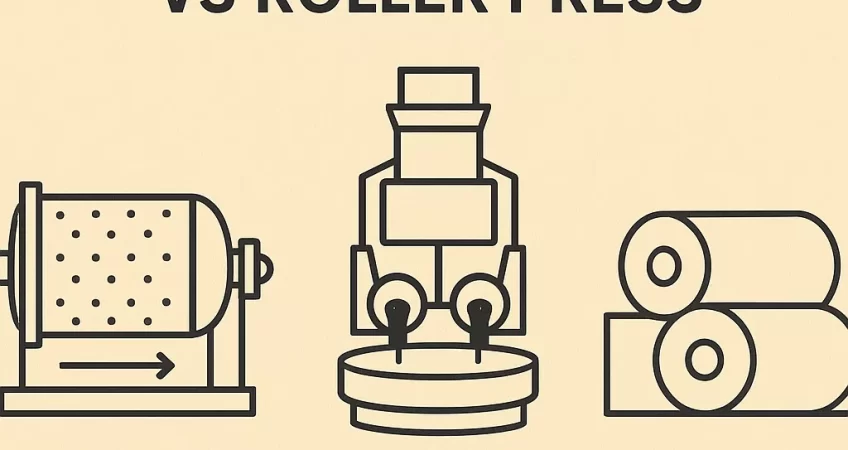
The ball mill principle is relatively simple: a rotating cylinder filled with steel balls (grinding media) uses impact and attrition to reduce particle size. As the shell rotates, the balls are lifted and dropped onto the material. Understanding the ball mill diagram is essential for operators to optimize the lifting liners and speed.
Key Characteristics
- Versatility: The ball mill grinder is capable of grinding various materials, from clinker to raw minerals.
- Applications: Common ball mill uses include finish grinding in cement plants and raw material preparation in mining.
- Sizing: The ball mill size varies significantly, ranging from small lab-scale units to massive industrial cylinders.
Pros and Cons
- Pros: Simple construction, low maintenance complexity, and excellent reliability.
- Cons: High specific energy consumption compared to modern alternatives.
(Note: While discussing industrial mills, it is important to distinguish them from other tools. For example, a hammer mill is used primarily for crushing rather than fine grinding and a ball end mill is a cutting tool used in CNC machining, not cement production.)
Section 2: Vertical Roller Mill (VRM)—The Efficiency Champion
The VRM cement mill revolutionized the industry by combining drying, grinding and separation into a single unit.
Working Principle
In a VRM, the material is ground between a rotating table and large stationary rollers. Hot gas passes through the mill, drying the material simultaneously. This integration makes it highly efficient for materials with high moisture content.
Why Choose VRM?
- Energy Efficiency: VRMs typically consume 30-40% less energy than ball mills.
- Footprint: It requires less space as it eliminates the need for separate drying equipment.
- Control: It offers rapid response to changes in product quality requirements.
Section 3: Rollerpress (High Pressure Grinding Rolls)—The Pressure Powerhouse
The roller press machine, often referred to as High Pressure Grinding Rolls (HPGR), uses a different mechanism entirely.
What is Roller Press Technology?
So, what is roller press technology? Unlike the impact force of a ball mill, a hydraulic roller press passes material between two counter-rotating rolls. One roll is fixed and the other is movable, applying immense hydraulic pressure to crush the material.
Key Characteristics
- Technology Leaders: Brands like Roller press KHD have set high standards in this domain.
- Maintenance: Understanding roller press parts, such as the studs and cheek plates, is vital for longevity.
- Application: It is often used for pre-grinding to increase the capacity of existing ball mills or as a finish grinding system.
Comparative Analysis: Which One Wins?
When looking at a ball mill vs VRM vs rollerpress comparison, the decision usually depends on specific plant goals.
1. Energy Consumption
- Winner: Rollerpress and VRM.
- Analysis: The Rollerpress is generally the most energy-efficient for grinding, followed closely by the VRM. The ball mill lags significantly in this area.
2. Maintenance and Wear
- Winner: Ball Mill.
- Analysis: Ball mills are easier to maintain. Roller press cement mill systems require specialized maintenance for hydraulic systems and roll surfaces.
3. Product Quality
- Winner: Ball Mill.
- Analysis: For cement, ball mills often produce a wider particle size distribution (PSD), which is desirable for cement strength development.
4. Capital Cost (Price)
- Winner: Ball Mill.
- Analysis: If you are looking at ball mill price alone, it is generally the cheapest capital investment. However, operational costs (OPEX) are higher.
Strategic Tips for Selection
If you are evaluating ball mill for sale listings or considering a new VRM, keep these tips in mind:
- Analyze Moisture Content: If your raw material has moisture above 5-6%, a VRM is superior due to its drying capabilities.
- Consider Cement Quality: If making high-grade cement, a combined system (Rollerpress + Ball Mill) often yields the best balance of efficiency and quality.
- Evaluate Space: Urban plants in Mumbai often have space constraints; VRMs utilize vertical space better than long horizontal ball mills.
- Review Technical Literature: Always consult a roller press comparison pdf or technical manual for specific performance curves before deciding.
Common Mistakes to Avoid
- Ignoring Material Hardness: Using a standard VRM for extremely abrasive materials without proper wear protection can lead to disastrous maintenance costs.
- Oversizing the Motor: Miscalculating the specific power consumption leads to buying oversized motors, increasing initial CAPEX unnecessarily.
- Neglecting Hydraulics: In a hydraulic roller press, failing to maintain the oil quality in the hydraulic system causes pressure failures and operational downtime.
- Confusing Terminology: Ensure your procurement team knows the difference between a hammer mill (crusher) and these fine grinding mills.
TECHCEM Expertise: Engineering Your Success
At TECHCEM Consultancy and Engineering Pvt. Ltd., we have successfully guided numerous projects across India.
- Feasibility Studies: We analyze whether a roller press cement plant pdf design fits your specific geology and market.
- Brownfield Optimization: We specialize in retrofitting Rollerpresses into existing Ball Mill circuits to boost output by 30-50%.
- Certifications: Our team adheres to ISO standards and Indian Bureau of Mines regulations.
Frequently Asked Questions
1. Is a used ball mill for sale a good investment?
It can be, provided the shell integrity is tested. However, ensure the ball mill price savings aren’t negated by high energy bills later. Consult TECHCEM for a valuation.
2. Where can I find a roller press in cement plant pdf for layout planning?
While general layouts are available online, every plant is unique. TECHCEM creates customized general arrangement drawings (GAD) tailored to your site conditions in Mumbai or elsewhere.
3. What is the main difference between a VRM and a Rollerpress?
A VRM grinds and dries using rollers on a table with airflow for transport. A roller press machine crushes material between two rolls using high pressure, usually requiring a separate separator and bucket elevator.
4. Can I use a ball mill for all types of cement?
Yes, the ball mill grinder is the most versatile regarding product types, but it may not be the most economical choice for all grades.
Choosing between a Ball Mill, VRM and Rollerpress requires balancing capital costs, energy targets, and product quality needs. While the Ball Mill offers simplicity, the VRM and Rollerpress offer the efficiency required for the modern, sustainable world.
Don’t navigate this complex engineering landscape alone. For specialized advice, project management and engineering solutions, partner with TECHCEM Consultancy and Engineering Pvt. Ltd. in Mumbai. Let us help you build a plant that is efficient, profitable and future-ready.
Contact us TECHCEM today to optimize your grinding process.