
Table of Contents
- What Is Robotic Baghouse Inspection?
- Why Traditional Baghouse Inspection Is Challenging
- How Robotic Baghouse Inspection Works
- Technologies Involved in Industrial Inspection Robotics
- Defects and Issues Robots Can Identify
- Robotic Inspection vs. Traditional Inspection
- Applications in Cement and Process Industries
- Supporting Preventive and Predictive Maintenance
- Why Choose Us
- Final Thought
Robotics for Baghouse Inspection is changing how cement and process plants monitor one of their most critical yet hardest-to-access assets – the baghouse dust collector. Traditional inspection methods often mean shutting down equipment, sending personnel into confined spaces, and relying on visual checks that miss early-stage defects. Robotic baghouse inspection solves these problems by combining automated sensors, imaging, and data analytics to deliver faster, safer, and more accurate results.
For plant managers and maintenance engineers, this shift isn’t just a technology upgrade – it’s a way to protect equipment uptime, reduce emissions risk, and extend the life of costly filtration systems.
What Is Robotic Baghouse Inspection?
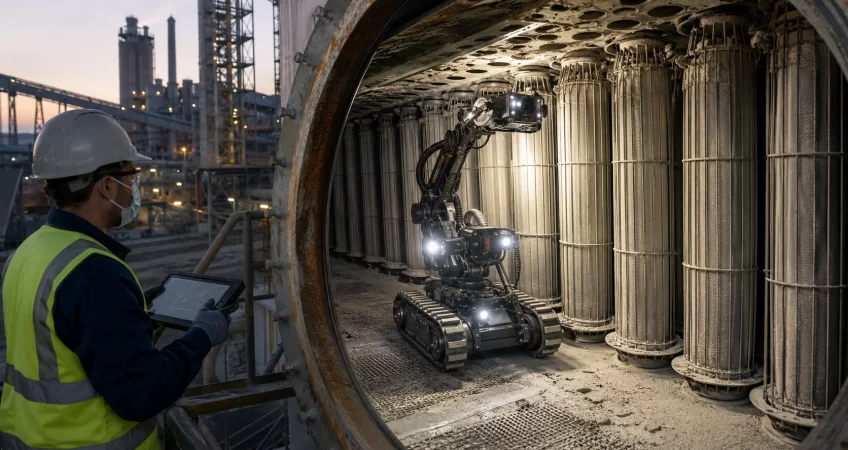
Robotic baghouse inspection uses remote-operated or semi-autonomous robotic systems to examine the internal condition of baghouse compartments, filter bags, cages, and tube sheets. These systems typically carry high-resolution cameras, sensors, and sometimes laser or ultrasonic scanning tools.
Instead of a technician entering a confined space, the robot navigates the compartment and captures detailed visual and sensor data. This data is then reviewed to assess bag condition, dust buildup, structural wear, and potential leak points.
Why Traditional Baghouse Inspection Is Challenging
Manual inspection of baghouses has long been a difficult and resource-intensive task. Several factors make it inefficient and sometimes risky:
- Confined space entry requires strict safety protocols, permits, and standby personnel
- Full or partial shutdowns are often needed, resulting in production downtime
- Poor visibility inside compartments limits how much a technician can accurately assess
- Dust, residual chemicals, and structural obstructions increase physical risk
- Human inspection is subjective and can miss small or early-stage defects
These challenges often lead to inspections being delayed or performed less frequently than ideal, increasing the risk of unplanned failures.
How Robotic Baghouse Inspection Works
Automated baghouse inspection systems are typically deployed through access ports or hatches, minimizing the need for full compartment entry. The robot moves through the compartment capturing images and sensor readings along filter bags, cages, tube sheets, and hopper areas.
Captured data is transmitted to inspection software, where engineers review footage and sensor readings to identify wear patterns, damage, or abnormalities. Some systems also generate inspection reports that can be compared against previous scans to track degradation over time.
This approach allows inspections to be completed with less downtime and significantly reduced confined space exposure for personnel.
Technologies Involved in Industrial Inspection Robotics
Industrial inspection robotics used in baghouse applications generally combine several technologies working together:
- High-definition and low-light cameras for detailed visual inspection
- LED or specialized lighting systems for visibility in dark compartments
- Remote-controlled or semi-autonomous mobility systems suited to compartment layouts
- Data logging and reporting software for defect tracking and historical comparison
- In some systems, sensors capable of detecting temperature or airflow irregularities
The specific technology mix depends on the baghouse design, compartment size, and the type of defects being monitored.
Defects and Issues Robots Can Identify
Robotic baghouse inspection is particularly effective at detecting issues that are difficult to catch through manual observation alone, including:
- Torn, worn, or degraded filter bags
- Cage damage or deformation affecting bag support
- Dust cake buildup or uneven dust distribution
- Signs of air bypass or leakage points
- Corrosion or structural wear on tube sheets and internal components
Early identification of these issues allows maintenance teams to plan repairs before they escalate into filter media failure or emissions non-compliance.
Robotic Inspection vs. Traditional Inspection
Traditional and robotic inspection methods differ significantly in coverage, safety, and consistency. Traditional inspection depends heavily on human visual assessment and physical access, which limits both frequency and thoroughness.
Robotic baghouse inspection, by contrast, provides more consistent documentation, reduces confined space risk, and often allows inspections to happen with reduced downtime. It also creates a visual and data record that can be reviewed later or compared across multiple inspection cycles – something traditional methods rarely offer in the same detail.
This doesn’t mean robotics fully replace human expertise. Engineers still interpret the data, make maintenance decisions, and validate findings – robotics simply improve the quality and safety of the information they work with.
Applications in Cement and Process Industries
Cement plant inspection is one of the most demanding use cases for baghouse maintenance due to high dust loads, abrasive particulates, and continuous operation requirements. Robotic baghouse inspection helps cement facilities monitor filter condition without extending shutdown windows longer than necessary.
Beyond cement, process industries such as power generation, mineral processing, and bulk material handling also rely on dust collector inspection to maintain air quality compliance and protect downstream equipment from particulate damage.
Supporting Preventive and Predictive Maintenance
One of the most valuable outcomes of robotic baghouse inspection is its contribution to predictive maintenance strategies. By capturing consistent, comparable inspection data over time, plants can identify wear trends before they result in failure.
This shifts baghouse maintenance from a reactive, failure-driven approach to a planned, condition-based one. Maintenance teams can schedule bag replacements, cage repairs, and structural fixes proactively, reducing unplanned downtime and helping maintain consistent filtration performance.
Why Choose Us
TECHCEM Consulting and Engineering works with cement and process plants to strengthen equipment reliability and maintenance planning. Our team understands the operational realities of baghouse systems and helps plants evaluate inspection strategies that align with their production schedules and compliance requirements.
Rather than offering generic recommendations, TECHCEM focuses on practical, plant-specific guidance – helping maintenance teams understand where robotic inspection fits into their broader preventive maintenance approach.
Final Thought
Robotics for Baghouse Inspection is reshaping how industrial plants monitor and maintain their dust collection systems. By reducing confined space risk, improving inspection consistency, and supporting predictive maintenance planning, robotic baghouse inspection offers a practical path toward more reliable operations.
If your plant is exploring ways to improve baghouse maintenance and reduce downtime risk, TECHCEM Consulting and Engineering can help you evaluate the right inspection and maintenance strategy for your facility. Reach out to our team to start the conversation.