
Table of Contents
The cement industry is one of the most challenging industries. Abrasive dust, high temperatures and heavy-duty rotating equipment and constant production cycles put immense stress on machines every day. A minor issue with equipment could result in unexpected downtime, loss of production as well as costly repair costs.
The traditional methods of maintenance that include periodic inspections and preventive services continue to be important, however they frequently do not reveal hidden problems occurring within the equipment. Bearings can wear out gradually, with no obvious indications, while motors may consume more energy due to internal issues, and even a small increase in the temperature of the shells for kilns may indicate a major issue prior to visible damage being noticed.
This is where Industrial Internet of Things (IIoT) sensors are transforming cement manufacturing.Instead of reacting to failures, IIoT sensors continuously monitor equipment health and process conditions in real time. They gather operational information that aids maintenance teams in identifying the early warning signs, improve production processes, increase energy efficiency and take educated decisions based on the actual performance of the equipment. While cement factories continue to undergo digital transformation, IIoT sensors have become an important tool to improve efficiency, cutting down on maintenance expenses as well as enabling greener operations.
Why Smart Monitoring Matters
The production of cement is a continuous process in which each step depends on the operation that is reliable of the preceding one. In the event of a failure, a single crusher, grinding mill or rotary kiln may cause disruption to the whole production line.
Industrial IoT sensors offer continuous visibility of critical equipment through checking parameters, such as
- Vibration
- Temperature
- Pressure
- Consumption of power and current in the motor
- The flow of gas and air
- Levels of material
- Dust concentration
- Emissions from the process
Instead of relying upon routine inspections, engineers get actual-time data on operations that allow them to spot abnormalities prior to them turning into major issues. Moving from reactive to condition-based is a major benefit of Industrial IoT within modern cement plants.
Where Industrial IoT Sensors Are Used
Industrial IoT sensors are positioned throughout all stages of the cement manufacturing process to help operators increase quality of the equipment as well as process efficiency.
Raw Material Handling
Raw material handling systems, such as stackers, conveyors, crushers, feeders and stackers run continuously even under the heaviest demands. Sensors track the speed of conveyors, vibrations along with motor current as well as storage levels to spot concerns like belt misalignment or wear to bearings overloaded loads before flow can be interrupted.
Crushers and Grinding Mills
Grinding mills and crushers face continuous mechanical strain. The temperature, vibration, sound, acoustic, as well as sensors for lubrication help to detect problems with bearing wear, imbalance as well as lubrication issues. the increase in mechanical resistance.
Instead of replacing parts dependent on their operating hours, maintenance staff will schedule repairs in accordance with the situation of the equipment, decreasing the need for maintenance, while increasing efficiency.
Rotary Kiln
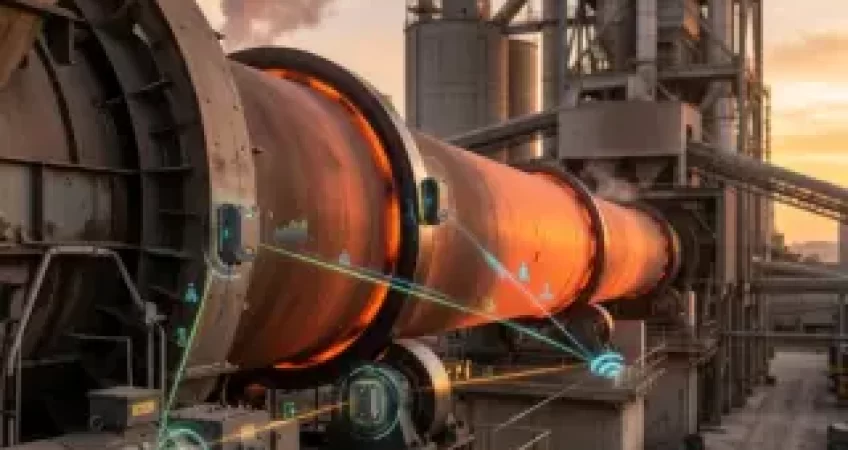
The rotary kiln constitutes the core of any cement plant. It operates at temperatures of 1,400 degrees Celsius or more. Monitoring is vital in order to ensure stable production and to avoid costly shutdowns.
Common monitoring points are:
- Temperature of the Kiln Shell
- Support roller bearings
- Gearbox vibrates
- Kiln drive motor current
- Flux of fuel
- Combustion gases
- Internal pressure
A gradual increase in vibration of the bearing with an increase in temperature typically is a sign of wear. The early detection of these signs allows maintenance staff to schedule repairs for scheduled shutdowns, rather than having to deal with emergencies with a failure.
Clinker Cooler
The cooler for the clinker contains fans as well as transporters, hydraulics systems as well as mechanical parts which require constant monitoring.
Sensors monitor:
- Air flow to cool
- Fan vibrating
- Temperature of bearings
- Motor in operation
- Pressure of hydraulics
A stable and consistent cooling environment improves the efficiency of heat recuperation, decreases the energy consumed, and also extends the life of equipment.
Cement Grinding, Packing and Dispatch
At the end of production, IIoT sensors monitor grinding mills, separators and conveyors storage silos, as well as packing equipment.
The sensors help improve the consistency of grinding, improve the consistency of grinding, decrease equipment failures, improve the accuracy of bagging, and ensure that the finished cement can be delivered with no unneeded delays.
Turning Sensor Data into Action
Sensors alone will make a difference to plant performance. They are most effective in the transformation of thousands of data points into useful insights.
In the case of a minor rise in the frequency of vibration might be insignificant by itself. When it’s added to a rising temperature for bearings as well as a greater motor current it can be a reliable sign of wear and tear on the mechanical. It allows maintenance personnel to tackle issues prior to them resulting in a sudden downtime.
Additionally, the data from sensors can help shift strategies for maintenance away from reactive repair to proactive maintenance. It reduces the cost of repairs while increasing overall equipment reliability.
Key Benefits of Industrial IoT Sensors
Industrial IoT sensors go beyond providing data. They enable better informed, data-driven choices that enhance performance, reliability, as well as safety throughout the plant.
Predictive Maintenance
The traditional maintenance process often relies on a fixed schedule or repair following equipment failure. IIoT sensors continuously monitor the temperature, vibration fluidity, and motor loads to identify warning signs of wear. It allows maintenance personnel to program repairs for planned maintenance shutdowns, thus reducing the chance of failures that happen unexpectedly while also extending the lifespan of equipment as well as assisting in the planning of spare parts.
Better Process Stability
The consistency of the process conditions is crucial for the production of top-quality cement. Sensors monitor constantly critical variables like kiln temperatures as well as combustion gases, airflow and the performance of grinding and help operators spot processes that are not in order before they impact the quality of clinker or efficiency of mills.
Improved Energy Efficiency
Cement production is among the industries that consume the most energy. Based on the International Energy Agency (IEA) the improvement of efficiency in energy use is a major goal to reduce operating costs as well as emission. IIoT sensors aid in identifying energy losses due to overloaded motors, poorly-performing fans, compressed air leaks as well as cooling systems that are not performing properly which allows plants to maximize energy usage at a real time.
Enhanced Safety
Monitoring continuously also enhances worker safety. Sensors are able to detect bearings that have been overheated or abnormal vibrations in equipment, high dust or dangerous gas levels before they cause unsafe situations. This allows workers to react quickly and decrease the risk of accidents.
Implementation Best Practices
Effectively implementing Industrial IoT sensors requires more than simply installing the hardware. Facilities should start by monitoring crucial equipment in areas where breakdowns cause the most significant impact on operation and not collecting excessive information from each machine.
It is equally important to ensure that the sensor’s data are translated into meaningful actions. Trends from the past as well as condition monitoring software and well-trained maintenance staff assist in converting information from sensors into well-informed maintenance decision-making.
The regular calibration of sensors, security industrial networks and the proper integration of existing equipment is also crucial to maintaining a high level of performance. Since many cement facilities use old machinery, new wireless sensors make the retrofitting of existing equipment much easier and cost-effective.
Supporting Sustainable Cement Manufacturing
Industrial IoT sensors aid in sustainability as they help plants run more effectively while decreasing their environmental footprint. Continuous monitoring helps to optimize energy consumption, less energy consumption, better burning efficiency and reduces the amount of waste material.
Continuous monitoring helps prolong the life of equipment and enhance emission management. This helps to ensure sustainability while decreasing the carbon footprint associated with cement manufacturing.
The Future of IIoT in Cement Plants
Digital technology continues to transform the manufacturing of cement. A variety of new developments are predicted to increase the benefits Industrial IoT
- Artificial Intelligence (AI): The analysis of sensor data helps to identify malfunctions in equipment and recommend the corrective actions to take.
- Edge Computing: Processes information close to equipment and allows for faster operational decision-making and decreasing communication delays.
- Digital Twins: Make virtual models of equipment in the plant by using sensor data in real-time, permitting engineers to model the performance of their equipment and improve maintenance plans without disrupting production.
In combination, these tools can help cement producers improve their productivity, cut down time, and take more informed operations-related decisions.
Conclusion
Industrial IoT sensors are now an essential component in modern cement production. They provide continuous monitoring of machine health and performance The sensors allow factories to shift from routine maintenance into proactive, data-driven operation.
Apart from preventing the failure of equipment they also improve productivity stability, cut down on energy use, increase workers’ safety and help achieve the sustainability objectives. Their true value isn’t in the amount of sensors that are installed however, but rather in the practical information they offer. If they are combined with expertise in engineering and effective maintenance methods, industrial IoT sensors can help construct more efficient, reliable and future-proof cement plants.
Need expert help with this? See how TECHCEM’s inspection & field services can support your project.