Table of Contents
The construction industry stands at a critical crossroads. As global infrastructure demands rise, so does the urgent need to address the environmental cost of building. Traditional cement production is a major contributor to global carbon emissions, prompting a swift shift toward more sustainable practices. At TECHCEM Consultancy and Engineering Pvt. Ltd., we understand that the future of construction relies on innovation.
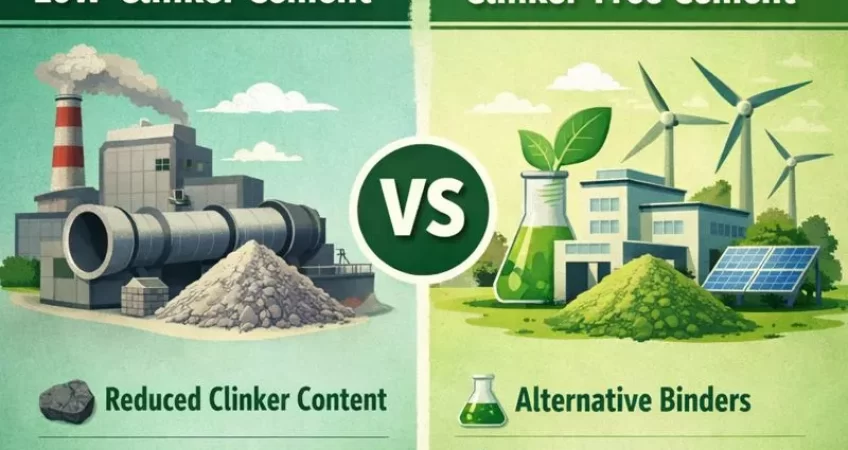
Adopting Green Cement Technology is no longer just an option; it is a necessity for a sustainable future. However, navigating the landscape of sustainable cement solutions can be complex. Two primary contenders have emerged in the race for decarbonization: low clinker cement and clinker free cement. Understanding the nuances between these two technologies is essential for developers, engineers and stakeholders aiming to reduce their carbon footprint without compromising structural integrity.
What is Green Cement Technology?
Green Cement Technology refers to manufacturing processes and material compositions designed to significantly reduce the environmental impact associated with cement production. Traditional Portland cement relies heavily on clinker a nodular material produced by heating limestone and clay at extremely high temperatures. This process releases massive amounts of CO2.
Low carbon cement aims to mitigate this by either reducing the amount of clinker used or eliminating it entirely. By incorporating industrial by-products like fly ash, slag, or calcined clay, these eco-friendly cement alternatives help lower energy consumption and greenhouse gas emissions, paving the way for a cleaner construction industry.
What is Low Clinker Cement?
Low clinker cement is a type of blended cement where a significant portion of the energy-intensive clinker is replaced with Supplementary Cementitious Materials (SCMs). Common SCMs include fly ash from power plants, blast furnace slag from steel manufacturing, or limestone calcined clay.
Low Clinker Cement Benefits
The primary appeal of this technology lies in its balance between sustainability and familiarity. Low clinker cement benefits include:
- Reduced Carbon Emissions: By lowering the clinker-to-cement ratio, manufacturers can achieve immediate reductions in CO2 emissions.
- Enhanced Durability: The addition of SCMs often improves the long-term durability of concrete, making it more resistant to chemical attacks and thermal cracking.
- Cost-Effectiveness: Utilizing industrial by-products can often reduce raw material costs compared to producing pure clinker.
Low clinker cement is particularly well-suited for large-scale infrastructure where standard performance metrics must be met with established supply chains.
What is Clinker Free Cement?
Taking sustainability a step further, clinker free cement eliminates the use of Portland clinker altogether. Instead, these decarbonized cement solutions rely on alkali-activated materials (geopolymers) or other novel chemistries to bind aggregates.
Clinker Free Cement Advantages
The environmental potential here is massive. Clinker free cement advantages include:
- Ultra-Low Carbon Footprint: Without the high-temperature kiln process required for clinker, these cements offer the deepest cuts in carbon emissions.
- Waste Utilization: These formulations often use up to 100% industrial waste materials, contributing to a circular economy.
- High Early Strength: Some clinker-free formulations offer rapid setting times and high early strength, which can be advantageous for specific precast applications.
This technology represents the cutting edge of net zero cement solutions, pushing the boundaries of what is possible in green cement for green buildings.
Low Clinker vs. Clinker Free Cement: A Detailed Comparison
When conducting a green cement comparison, it is crucial to weigh the pros and cons of low clinker vs clinker free cement based on specific project requirements.
Performance and Durability
- Low clinker cement: behaves very similarly to traditional Portland cement, making it easier for contractors to adopt without changing their construction methods significantly. It offers excellent long-term strength and durability.
- Clinker free cement: while offering superior resistance to acids and fire, can behave differently regarding setting times and workability. It may require specialized handling or additives to match the workability of traditional concrete.
Cost and Availability
Currently, low clinker cement is more widely available and generally more cost-effective due to established supply chains for SCMs. Clinker free cement is often considered a premium product, though costs are expected to decrease as next generation cement technology scales up.
Environmental Impact
If the question is “which cement has lowest carbon footprint?”, the answer is almost invariably clinker-free cement. However, low clinker options still offer substantial reductions often between 30% to 50% less CO2 than traditional OPC making them a high-impact, immediate solution for sustainable cement for construction.
Best Green Cement Technology: Which Should You Choose?
Determining the best green cement technology depends on your project goals.
For massive infrastructure projects requiring standard specifications and cost control, low carbon cement for infrastructure projects (specifically low clinker variants) is often the pragmatic choice. It delivers sustainability at scale.
Conversely, for projects targeting high-level LEED or BREEAM certifications, or where maximum carbon reduction is the primary KPI, cement alternatives for sustainable construction like clinker-free formulations are ideal.
Applications and Use Cases
The versatility of green cement is evident in its growing adoption across the globe.
- Residential and Commercial Buildings: Green cement for green buildings is becoming standard specification. Low clinker options are perfect for foundations, slabs, and structural columns.
- Infrastructure: Bridges, dams, and roads benefit from the reduced heat of hydration found in blended, low-clinker cements, which minimizes thermal cracking.
- Precast Concrete: Clinker free cement is finding a niche in precast elements like pavers and blocks, where the curing environment can be controlled to maximize the material’s properties.
Future Trends and Innovations
The future of green cement is dynamic and promising. We are moving toward cement decarbonization technologies that go beyond simple substitution.
Innovations include Carbon Capture, Utilization and Storage (CCUS) integrated directly into cement plants, and the development of bio-based cements. As next generation cement technology evolves, we expect to see “smart” cements that can self-heal cracks or sequester CO2 from the atmosphere throughout their lifecycle.
The transition to sustainable construction is not a distant goal it is happening now. Whether you opt for the reliability of low clinker cement or the revolutionary potential of clinker free cement, the move away from traditional high-emission materials is vital.
At TECHCEM Consultancy and Engineering Pvt. Ltd., we are committed to guiding the industry toward net zero cement solutions. Through our specialized cement plant consultancy services, we help stakeholders integrate sustainable technologies without compromising operational efficiency. By understanding the specific benefits of low clinker vs clinker free cement, stakeholders can make informed decisions that benefit both their projects and the planet. We encourage you to explore these sustainable cement solutions and join us in building a greener, more resilient world.