
Table of Contents
Cement plant expansion is one of the most capital-intensive undertakings in the industrial sector. Whether a manufacturer is adding a new kiln line, increasing clinker capacity, or integrating alternative fuel systems, the complexity of such projects demands far more than engineering precision — it demands a structured, proactive approach to risk management. Without it, even well-funded expansion projects can spiral into costly delays, regulatory setbacks, or long-term operational liabilities.
This guide examines the key risk categories in cement plant expansion projects and outlines practical strategies that plant owners, EPC contractors, and project managers must prioritize from the planning phase through commissioning.
Why Risk Management Is Critical in Cement Expansion
Cement plant expansions typically involve multi-crore investments spread across two to five years. The interaction between civil construction, process engineering, equipment procurement, environmental compliance, and workforce management creates a web of interdependencies where a single failure point can trigger cascading delays across the entire project timeline.
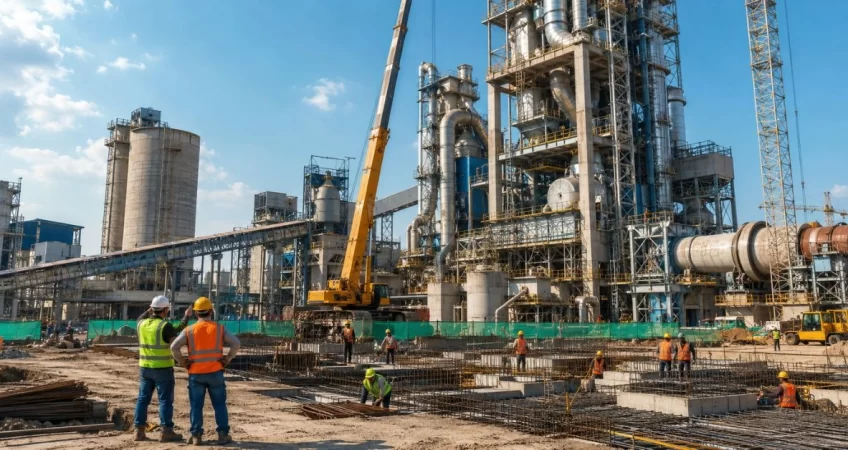
Unlike greenfield projects built on clean sites, expansions must often run alongside existing production operations. This “brownfield” nature adds a layer of complexity — live electrical systems, active process areas, and ongoing production targets all coexist with construction activity. Managing this environment safely and efficiently is where risk planning earns its value most clearly.
Key Risk Categories in Cement Plant Expansion
1. Technical and Engineering Risks
Technical risks are among the most common causes of cost overruns in cement expansion projects. These include design errors, equipment compatibility issues, civil foundation failures, and process integration challenges. A new kiln or grinding circuit must integrate seamlessly with existing raw material handling, pyroprocessing, and dispatch systems — any mismatch can result in downtime that affects not just the new line but the entire plant.
Thorough Front-End Engineering Design (FEED) studies, independent technical audits, and equipment factory acceptance testing (FAT) are non-negotiable controls that reduce technical risk significantly before site work begins.
2. Financial and Budget Risks
Budget overruns in cement expansion projects often stem from scope creep, material price volatility, foreign exchange fluctuations (particularly for imported equipment), and underestimated contingency planning. Projects that rely heavily on imported clinker coolers, vertical roller mills, or automation systems are particularly exposed to currency risk.
Effective financial risk management requires detailed cost estimation with built-in contingency buffers of at least 10–15%, fixed-price contracts where feasible, and regular earned value analysis (EVA) to track cost performance against the project baseline throughout execution.
3. Schedule and Timeline Risks
Timeline risk is arguably the most visible form of project risk because delays directly impact production capacity and market commitments. Common causes include late equipment delivery, monsoon disruptions to civil work, labour shortages, permit delays, and poor interface management between multiple contractors working on the same site.
Critical path analysis, contractor performance monitoring, and clearly defined milestone-based payment structures are essential tools for keeping cement expansion projects on schedule.
4. Environmental and Regulatory Risks
Cement manufacturing is a heavily regulated industry in India, subject to environmental clearances under the EIA Notification, Consent to Establish (CTE) and Consent to Operate (CTO) requirements under state pollution control boards, and forest and water use approvals where applicable. Regulatory delays are among the leading causes of project timeline slippage in the cement sector.
Early engagement with regulatory bodies, appointment of a dedicated compliance manager, and maintaining complete documentation from day one are critical steps. Projects that attempt to fast-track construction before all clearances are in place expose themselves to stop-work orders and legal complications that dwarf the cost of proper pre-project compliance work.
5. Health, Safety, and Environment (HSE) Risks
Construction fatalities and serious injuries are a real risk in any large industrial project, but cement plants present specific hazards — confined spaces, high-temperature equipment, rotating machinery, and elevated work in kiln and preheater structures. Brownfield sites compound this with live process areas adjacent to active construction zones.
A robust HSE management plan, contractor safety audits, permit-to-work systems, and zero-tolerance enforcement of safety violations are not just ethical obligations — they are project risk controls. Accidents cause delays, legal liability, and reputational damage that affect future project financing and community relations.
Key Risk Mitigation Strategies at a Glance
- FEED Study: Invest in detailed pre-engineering to identify design risks before procurement begins.
- Risk Register: Maintain a live risk register updated at every project review — assign owners, probability ratings, and mitigation actions to each risk.
- Contractor Prequalification: Evaluate contractors not just on price but on their track record, financial health, and HSE performance on similar projects.
- Insurance Coverage: Secure adequate Contractor’s All Risk (CAR) insurance, third-party liability, and delay-in-startup (DSU) coverage from project initiation.
- Change Control Protocol: Establish a formal change management process — uncontrolled scope changes are one of the top contributors to cost and schedule overruns.
The Role of Technology in Modern Risk Management
Digital tools are increasingly transforming how cement project teams identify and manage risk. Project management platforms with integrated scheduling, cost tracking, and document control give owners real-time visibility into project health. BIM (Building Information Modelling) allows clash detection in design before it becomes a field problem. IoT-based construction monitoring and drone site surveys allow remote progress tracking and early identification of deviations from plan.
In India’s cement sector, larger groups like UltraTech, Shree Cement, and Dalmia Bharat have adopted structured project governance frameworks for their expansion programmes. Mid-sized manufacturers expanding capacity would benefit from adopting similar practices, even at a scale appropriate to their project size and team capability.
Risk Management Is a Continuous Process
One of the most common mistakes in cement plant expansion projects is treating risk management as a one-time exercise completed during project planning. In reality, the risk profile of any project evolves as construction progresses, market conditions change, and new stakeholders come into the picture. Effective risk management is iterative — risks identified at project sanction may be retired by month six, while new risks emerge as equipment arrives on site and commissioning approaches.
Monthly risk review meetings, integrated into the project’s governance structure, ensure that the project team remains alert to emerging threats and that mitigation plans are updated before risks materialise into actual problems.
Fina Thought
Cement plant expansion offers significant growth potential, but it is not without its challenges. Technical complexity, financial exposure, regulatory requirements, and safety obligations all demand disciplined risk management from project conception to commercial production. Companies that invest in structured risk planning – and maintain that discipline throughout the project lifecycle — consistently deliver expansions closer to budget, on time, and with fewer post-commissioning surprises.
In an industry where margins are tightly linked to operational efficiency and capacity utilisation, the ability to execute expansion projects well is itself a competitive advantage.
Need expert help with this? See how TECHCEM’s project management services can support your project.