
Table of Contents
- Brownfield Cement Plant Expansion: Where the Engineering Difficulty Actually Sits
- Three Things People Mean by “Brownfield”
- The Constraints That Decide Whether It Works
- Brownfield Cement Plant Expansion Versus Greenfield
- The Order of Work
- Frequently Asked Questions
- Is brownfield expansion cheaper than greenfield?
- How much capacity can be added without a new kiln?
- Does a brownfield expansion need a fresh environmental clearance?
- What is the biggest risk in a brownfield cement expansion?
- Can you expand a plant without stopping production?
- What is a tie-in register and why does it matter?
- Expanding an Operating Plant?
Brownfield Cement Plant Expansion: Where the Engineering Difficulty Actually Sits
Brownfield cement plant expansion has quietly become the default way India adds cement capacity. CRISIL Ratings estimates that around 65% of the capacity to be added between FY26 and FY28 will come through brownfield projects, and notes that this lowers the risk attached to the capex — because the land, the mine, the power connection, the water and the dispatch infrastructure already exist and are already paid for.
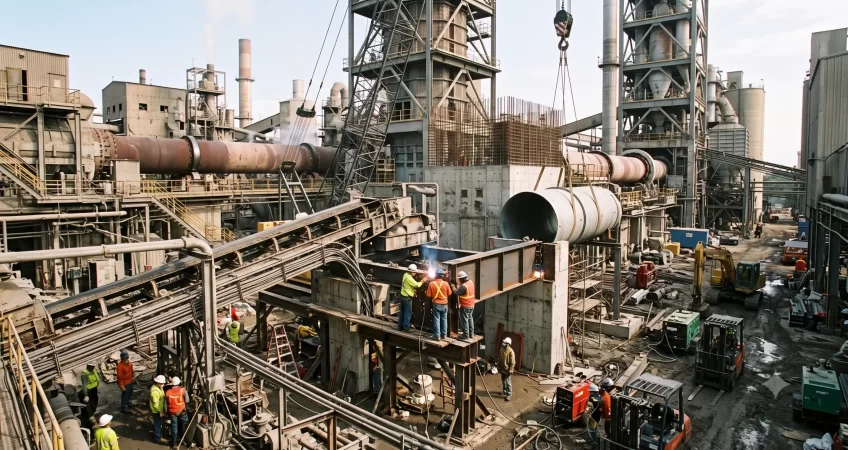
Lower financial risk, though, does not mean easier engineering. It means the opposite. A greenfield plant is designed on an empty site with no constraints beyond the process. A brownfield expansion has to be designed around an operating plant that cannot stop making cement, on a site laid out for a smaller plant, tying into systems that were sized for a different duty. The capital is smaller and the engineering is harder.
Three Things People Mean by “Brownfield”
The word covers three quite different projects, and the first question in any expansion discussion should be which one is meant.
Level 1 — Debottlenecking
No new production line. Existing equipment made to deliver what it was always capable of: separator and classifier corrections, false air elimination, fan and drive upgrades, cooler modifications, material distribution fixes, revised operating parameters. India Cements, for instance, has run a dedicated debottlenecking and efficiency programme alongside its capacity additions — treating recovered capacity as a capacity source in its own right.
Capital is modest, execution fits inside planned shutdowns, and there is no clearance implication until you cross the permitted capacity. The binding requirement is measurement: you cannot debottleneck a constraint you have not located, which is why this route starts with a cement plant technical audit.
Level 2 — A New Line at the Existing Site
A second clinker line, a new cement mill, an additional packing and dispatch stream. This is a full project with procurement, civil work and commissioning, executed inside a live plant. It reuses the mine, the infrastructure and the organisation.
Level 3 — A Split Grinding Unit Fed by Existing Clinker
Technically a new site, but commercially a brownfield move: it monetises clinker capacity you already have, closer to the market. Nearly two-thirds of India’s incoming capacity takes this form, because grinding units cost less and come on stream faster — typically 1-2 years against 3-4 years for an integrated plant. The four routes to capacity expansion are compared in more detail here.
The Constraints That Decide Whether It Works
Six of them, and they are engineering questions, not commercial ones.
Clinker Balance
The first calculation in any brownfield expansion. Cement capacity added without clinker to feed it is capacity on paper. The answer may be surplus clinker, a higher blend ratio to reduce the clinker factor, or a new clinker line — and each takes the project in a different direction. This is cement process engineering work, done before any equipment is specified.
Statutory Capacity Ceiling
The site’s existing environmental clearance permits a specific capacity. Exceeding it is not a paperwork exercise, and finding that out after equipment is ordered is a costly way to learn it. Establish the permitted ceiling before sizing anything.
Tie-Ins and Shutdown Windows
Every connection to the existing plant — electrical, process, material handling, utilities — has to be made in a window when the plant is down. Those windows are short, few, and planned a year ahead. Brownfield project schedules are built backwards from shutdown availability, and a tie-in that misses its window waits months for the next one. This is the single most common source of brownfield delay, and it is a design and planning failure, not a site failure.
Utilities Headroom
Power, compressed air, water and cooling were sized for the original plant. Each needs checking against the expanded duty, and the answers are rarely all yes. The same applies to the substation and the incoming connection, which is where E&I engineering for cement plants starts on a brownfield job.
Space and Layout
A site laid out for one line rarely has convenient room for another. Equipment positions, conveyor routes, crane access and maintenance clearance all get tighter, and a cement plant layout that works on paper but leaves no maintenance access will cost more over twenty years than it saved in construction.
Mine Reserves and Grade
Expanded capacity draws down the deposit faster. Reserve adequacy has to be re-established for the new rate across the intended plant life, and the raw mix has to work with the grade actually available at that rate — not the grade in the best part of the deposit.
Brownfield Cement Plant Expansion Versus Greenfield
- Capital per tonne. Brownfield is lower, because the infrastructure already exists. Greenfield builds everything from zero.
- Gestation. Brownfield is shorter. Greenfield is the longest of all expansion routes.
- Clearance path. Brownfield may stay within an existing capacity ceiling. Greenfield needs full clearance, land and a mining lease.
- Engineering difficulty. Brownfield is harder — tie-ins, shutdowns and site constraints. Greenfield is a clean sheet.
- Schedule risk. Brownfield risk concentrates in shutdown windows. Greenfield risk concentrates in approvals.
- Reserve position. Brownfield draws an existing deposit faster. Greenfield opens a new deposit for a full plant life.
- Best when. Brownfield suits sites where reserves and clinker allow growth. Greenfield is for when you need reserves in a new region.
The Order of Work
- Technical audit of the existing plant — the real constraint, the available headroom, and the condition of everything the new line will tie into.
- Clinker and reserve balance for the target capacity.
- Pre-feasibility comparing debottlenecking, a new line and a split grinding unit on cost per tonne and gestation.
- Feasibility study and DPR for the chosen route, including the package-wise capital estimate.
- Detail engineering with a tie-in register — every connection identified, sequenced and mapped to a shutdown window before construction starts.
- Execution and commissioning under project management, with the shutdown plan as the governing schedule document.
Step 5 is the one brownfield projects skip and then pay for. A tie-in register built during detail engineering, rather than discovered during construction, is the difference between a brownfield project that lands and one that drifts across two shutdown seasons.
Frequently Asked Questions
Is brownfield expansion cheaper than greenfield?
Per tonne of capacity, yes, and substantially — you reuse the mine, land, power, water and dispatch infrastructure. That is why brownfield and split grinding units dominate India’s current capacity pipeline. The trade-off is engineering complexity and schedule dependence on plant shutdowns.
How much capacity can be added without a new kiln?
It depends where the plant currently sits against its design parameters. Debottlenecking, higher blending to reduce the clinker factor, and a grinding unit fed by surplus clinker can all add cement capacity without new clinkerisation. A technical audit establishes how much is genuinely available before any of it is committed to a plan.
Does a brownfield expansion need a fresh environmental clearance?
It depends on whether the expansion stays within the capacity already permitted for the site. An increase beyond the sanctioned capacity of a cement plant requires prior environmental clearance in its own right, while work that stays inside the permitted ceiling generally does not. Because the applicable category and route depend on the plant type, capacity and location, establish the permitted ceiling and confirm the clearance route with your environmental consultant before sizing the expansion, not after.
What is the biggest risk in a brownfield cement expansion?
Tie-ins that miss their shutdown window. Everything else can usually be recovered; a missed window can mean months of waiting. It is prevented at detail engineering stage with a tie-in register, not managed at site.
Can you expand a plant without stopping production?
Most of the work, yes. The tie-ins themselves need the plant down, which is why they are planned into existing shutdowns rather than driving new ones. A well-sequenced brownfield project adds no unplanned shutdown days at all.
What is a tie-in register and why does it matter?
A document listing every physical connection the new work will make to the existing plant — electrical, process, material handling and utilities — with each one sequenced and assigned to a specific shutdown window. It is produced during detail engineering. Without it, tie-ins are discovered during construction, by which point the next shutdown window may be months away.
Expanding an Operating Plant?
TECHCEM works with cement producers across India on brownfield expansion, capacity enhancement and debottlenecking — starting from an audit of what the plant can actually do. See how our cement plant consultancy services can support your expansion, or call +91 81046 42385.