
Table of Contents
- Cement Plant Capacity Expansion in India: The Four Routes, and How to Choose
- Route 1 — Debottlenecking the Plant You Already Have
- Route 2 — A New Line at an Existing Site
- Route 3 — A Split Grinding Unit
- Route 4 — Greenfield, or Acquisition
- What Actually Decides the Route
- Planning Cement Plant Capacity Expansion in India: The Sequence That Avoids Rework
- Three Mistakes Worth Naming
- Frequently Asked Questions
- Planning an Expansion?
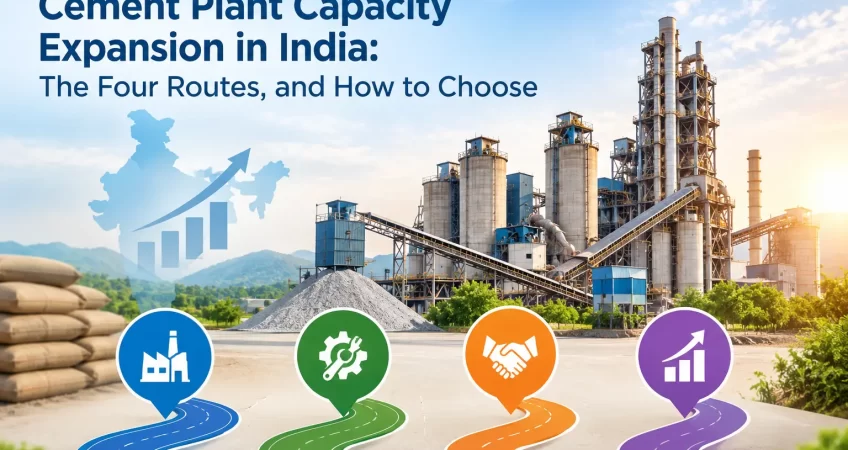
Cement Plant Capacity Expansion in India: The Four Routes, and How to Choose
Cement plant capacity expansion in India is running at its fastest rate in a decade. CRISIL Ratings expects 160-170 million tonnes of grinding capacity to be added between FY26 and FY28 — roughly 75% more than the 95 MT added over the previous three years — against industry capex of about ₹1.2 lakh crore. Nearly two-thirds of that new capacity is coming as split grinding units rather than integrated plants, because they cost less and come on stream faster.
That last point is the one most expansion decisions turn on. “Adding capacity” is not one decision. It is a choice between four quite different projects, with capital costs that differ by a factor of five and gestation periods that differ by years. Choosing the wrong route is the most expensive mistake available in a cement project, and it is usually made before any engineering starts.
Route 1 — Debottlenecking the Plant You Already Have
The cheapest tonne of cement is the one your existing equipment can already make but currently does not. Most Indian plants running for more than a decade have somewhere between 5% and 15% of rated capacity locked up in a constraint nobody has measured: a cooler recovering less heat than it should, a separator running at the wrong setting, false air in the preheater, or a mill circuit limited by classifier efficiency rather than mill power.
Debottlenecking typically means minor equipment changes — a fan upgrade, a separator retrofit, a cooler modification, sometimes only a change in operating philosophy. The capital is small, and there is no land, no clearance and no new mine involved. The catch is that you cannot plan it from a spreadsheet. It needs a cement plant technical audit that measures the actual constraint, because the bottleneck is rarely where operations assume it is.
Route 2 — A New Line at an Existing Site
Adding a clinker line or a grinding line inside an operating plant uses infrastructure you have already paid for: the mine, the power connection, the water, the colony, the dispatch. It is the reason brownfield expansion dominates current Indian capacity addition, and why the risk profile is lower than greenfield.
The engineering, though, is harder than greenfield. Every tie-in has to be designed around a plant that cannot stop producing. Shutdown windows are short and fixed. Space is constrained. Existing utilities may not have the headroom the new line needs, and the site’s environmental clearance may be capped below the capacity you want. These are solvable problems, but they are design problems, not procurement problems.
Route 3 — A Split Grinding Unit
A grinding unit near the market, fed by clinker from the parent plant, is where most of India’s new capacity is going. It is considerably less capital-intensive than an integrated plant, typically has a gestation period of 1-2 years against 3-4 years for an integrated cement plant, and cuts the primary lead distance — which in India is often a larger cost lever than the plant itself. Fly ash or slag availability near the site usually decides the location as much as the market does.
The constraint is clinker. A split grinding unit only works if the parent plant has surplus clinker, or if the clinker factor can be brought down through higher blending. If neither is true, a grinding unit adds cement capacity you cannot feed.
Route 4 — Greenfield, or Acquisition
A new integrated plant is the most capital-intensive and slowest route, and it is chosen for one reason: access to limestone reserves in a region where you have none. Land, mining lease, environmental clearance and infrastructure all start from zero, and the clearance path alone can take years.
Acquisition is the alternative, and Indian producers evaluate it on the same yardstick — cost per tonne of capacity acquired against cost per tonne of building new. When a distressed asset comes cheaper than greenfield, it wins. When it does not, organic growth wins. Either way the decision needs a technical due diligence of the target plant covering equipment condition, reserves and clinker capability, not just a valuation.
What Actually Decides the Route
Six questions settle it, and all six are answerable before you commit capital:
- Clinker balance. Do you have surplus clinker, or will new cement capacity outrun it? This single answer eliminates two of the four routes.
- Limestone reserves. Enough proven reserve for the expanded capacity across the intended plant life, at a grade the raw mix can carry?
- Existing plant headroom. How much of the target increase is available through debottlenecking, and at what cost per tonne compared with new equipment?
- Lead distance. Where is the demand, and what does delivery cost from your existing plant versus a grinding unit closer to market?
- Clearance and statutory capacity. What capacity does your current environmental clearance permit, and what does exceeding it require?
- Power and fuel. Can the existing supply carry the addition, and does the expansion justify waste heat recovery or captive renewable capacity alongside it?
Planning Cement Plant Capacity Expansion in India: The Sequence That Avoids Rework
Expansion projects that overrun almost always skipped a stage. The order that works:
- Technical audit of the existing plant. Establishes the real constraint and how much capacity is available without new equipment. Also the baseline every later claim is measured against.
- Pre-feasibility and conceptual engineering. Configuration options, capacity choices, indicative capital cost, plot plan. This is where the four routes are compared on numbers rather than opinion.
- Feasibility study and DPR. The chosen configuration engineered to the depth a lender or board needs — reserves, package-wise capex, operating cost per tonne, market assessment, financial model.
- Clearances and statutory approvals, run in parallel from the DPR stage, not after it.
- Detail engineering, procurement and project management through to commissioning.
Stages 1 and 2 together cost a fraction of a percent of the project and routinely change the answer to “which route”. Skipping them is how a company ends up building a grinding unit it cannot feed, or a clinker line for a market that was two states away. If you are testing a capital number at this stage, see our guide to cement plant project cost estimation in India.
Three Mistakes Worth Naming
- Sizing from market demand instead of from clinker and reserves. The market tells you how much cement you could sell. The mine and the pyro line tell you how much you can make. Projects sized on the first number and engineered against the second are the standard failure mode.
- Treating the environmental clearance as a formality. On brownfield expansion, the existing clearance capacity is a hard ceiling. Finding that out after ordering equipment is expensive.
- Ordering equipment before the constraint is measured. A new mill does not fix a separator problem, and a bigger fan does not fix false air. An audit first is cheaper than a retrofit later.
Frequently Asked Questions
What is the cheapest way to add cement capacity in India?
Debottlenecking the existing plant, by a wide margin — you are buying tonnes from equipment already installed. After that, split grinding units, which are less capital-intensive than integrated plants and come on stream faster, which is why nearly two-thirds of India’s new capacity is arriving in that form. Greenfield integrated plants are the most expensive and the slowest.
How long does a cement plant expansion take in India?
It depends on the route. Debottlenecking is quickest because it is executed inside planned shutdowns rather than driving its own schedule. A new line at an existing site is constrained mainly by the availability of shutdown windows for tie-ins. A split grinding unit typically takes 1-2 years against 3-4 years for an integrated cement plant, because there is no pyro line and no mine. Greenfield is the longest, because land acquisition, the mining lease and environmental clearance all run before construction can begin, and the clearance path alone can take years.
Do I need a DPR for a brownfield expansion?
If the expansion is being funded by a lender or needs board sanction, yes. Even when it is self-funded, a DPR is what forces the reserve position, the clinker balance and the capital estimate to be tested before commitment rather than after.
Can capacity be increased without adding a kiln?
Often, yes — through debottlenecking, higher blending to reduce the clinker factor, or a grinding unit fed by surplus clinker. All three add cement capacity without new clinkerisation. How much is available depends on where your plant currently sits against its design parameters, which is what a technical audit establishes.
Who should decide which expansion route to take?
Whoever is independent of the outcome. An equipment supplier will size a solution around its own product line and an EPC contractor will price the scope you hand over. The route decision sits earlier than both, and it is best taken on measured plant data and a reserve position rather than on a vendor proposal.
Planning an Expansion?
TECHCEM works with cement producers across India on capacity expansion — starting with a technical audit rather than a capacity assumption. See how our cement plant consultancy services can support your expansion decision, or call +91 81046 42385 to discuss your plant.