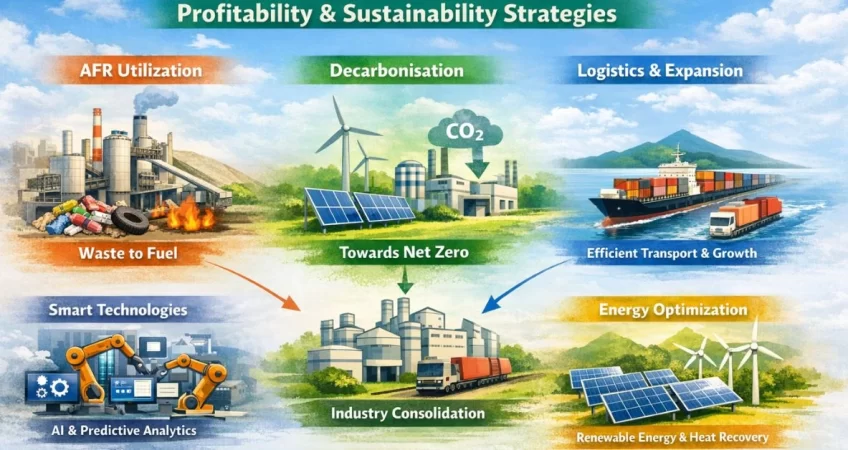
The Future Of Cement Industry is evolving rapidly as companies face rising costs, environmental pressure, and increasing competition. To stay profitable and relevant, businesses are now focusing on smarter strategies that combine operational efficiency, sustainability, and technology. From using waste as fuel to adopting artificial intelligence, the shift is clearly towards building a more optimized and future-ready ecosystem.
Strategy becomes a project at the feasibility stage — TECHCEM delivers that as a bankable feasibility report and DPR.
The Future of Cement Industry: Strategies Driving Profitability and Sustainability
The world of cement is changing quickly as businesses face increasing cost, environmental pressures as well as increasing competitiveness. In order to remain profitable and competitive firms are looking for strategies that blend sustainable operations, efficiency as well as technology. From the use of waste as fuel to embracing artificial intelligence it is clear that the trend is towards developing a more efficient and future-proof environment.
AFR Utilization: Converting Waste into Value
A major and significant shifts in the past few years is the usage in the use of Alternative Fuels and Raw Materials (AFR). Instead of solely relying on conventional fuels, such as coal, cement factories have been increasingly utilizing waste materials including the plastic of industrial and construction waste as well as discarded tire. This strategy not only decreases expenses for fuel, but it also addresses the increasing issue of the management of waste.
It’s a simple idea, but effective: what was previously considered waste can be a useful resource. In time, businesses who optimize their AFR use will see a significant increase in their profits and also comply with the environmental requirements.
Decarbonisation: Building a Net Zero Roadmap
Logistics Optimization: Improving Efficiency Across the Supply Chain
Because of the size and weight that cement is, its logistics play crucial roles in cost structure. A poor transportation plan can drastically affect the profitability. To combat this issue, firms are working to optimize their logistics systems by optimizing the location of their facilities, implementing multimodal transport methods, as well as improving the efficiency of distribution.
Transport by sea and rail are becoming more popular than road transportation because of their value and efficiency when traveling longer distances. In addition better logistics for warehouses help decrease delivery times and helps ensure better efficiency.
Strategic Investment Decisions: Clinker vs Grinding Units
The planning of investments is another important aspect that cement firms must make educated decision. The decision to set an clinker plant, or grinding facility is dependent heavily on the availability of capital and the market strategy.
Clinker plants give the full control of production, but need a significant investment, as well as a lengthy setup times. However grinding machines are efficient and less expensive to set up even though they rely on a supply of clinker from outside. It is essential for businesses to carefully consider their goals for the long term before taking this choice.
Expansion Strategy: Brownfield vs Greenfield Projects
In the case of capacity expansion, businesses typically select between brownfield and greenfield projects. Brownfield projects are those that involve repairing or expanding existing facilities which makes them more efficient and cost effective. Contrary to greenfield projects, they originate completely from scratch and require more investments and more time.
Although brownfield development can yield faster yields, greenfield projects give opportunities to combine new technology, and create an efficient layout for the plant. It all depends on the business’s growth plan as well as financial capacity.
Role of AI and Predictive Analytics in Modern Cement Plants
The technology revolutionizing cement manufacturing by using artificial intelligence, and predictive analytics playing an important function. They allow businesses to keep track of their the operations at a real-time pace and predict failures of equipment and improve production processes.
Instead of having to react to any issues when they arise, factories are now able to anticipate problems and implement preventative measures. This results in less time to repair, increased efficiency as well as consistent quality of product which ultimately increases overall profitability.
Industry Consolidation and Its Impact
The cement sector is experiencing consolidation with bigger firms acquiring smaller ones in order to increase their market share. The reason for this is the necessity to achieve economies of scale as well as better cost management as well as a wider market.
Smaller players are the ones who can create both challenges and opportunities. Although competition is tougher there’s also room for strategic alliances, or to focus on specific markets in order to remain competitive.
Managing Energy Costs for Better Profitability
Energy is one of the biggest cost components of cement production. This is why companies are constantly looking for methods to cut down on energy use and increase efficiency. It is a good idea to adopt methods to recover heat from waste as well as incorporating renewable energy sources and converting to energy-efficient equipment.
- Waste heat recovery systems to collect and recycle energy
- Utilization of solar and wind power sources to decrease dependence on traditional sources
- The investment in the most modern and energy efficient equipment
- Monitoring and continuous optimization of the energy use
They not only cut down on cost of operations but also contribute to the sustainability objectives, which makes them crucial to long-term success.
Final Thought
The industry of cement is heading towards an increasingly technological and strategic future. companies that are focused on maximizing resources, minimizing impacts on the environment, and making wise investment decisions are more likely to achieve success.
In adopting AFR use, enhancing logistical efficiency, implementing AI and utilizing energies efficiently, organizations are able to turn challenges into opportunities. In a highly competitive market innovation and change will eventually determine the industry’s top performers.