
Table of Contents
- Understanding Industrial Fans and Kilns
- Traditional Maintenance Approaches and Their Limitations
- What is AI-Based Vibration Analysis
- How AI Enhances Vibration Monitoring
- Application in Industrial Fans and Kilns
- Business Impact of AI-Driven Predictive Maintenance
- Implementation Challenges in Industrial Environments
- Best Practices for Successful Deployment
- Moving from reactive to Predictive Maintenance
In heavy industries such as steel, cement, and power generation, industrial fans and rotary kilns form the foundation of continuous production. In the event of an unexpected malfunction, these systems can halt operations instantly, leading to significant financial losses that may reach lakhs or even crores per hour. Beyond direct revenue impact, unplanned downtime can disrupt the supply chain, delay delivery schedules, and increase safety risks for on-site personnel.
Traditionally, many industries have relied on reactive or scheduled maintenance strategies. However, these approaches often fail to detect early warning signs of potential failures. As operations become more complex and cost-sensitive, there is a clear shift toward more advanced, data-driven approaches like predictive maintenance. This is where AI-based vibration analysis plays a crucial role, enabling companies to identify faults before they escalate and transforming how equipment health is monitored and managed.
Understanding Industrial Fans and Kilns
Why These Assets Are Critical to Operations
Industrial fans – such ones such as ID, FD, and PA fans – and rotary kilns work under harsh conditions, which include extremely high temperatures, heavy workloads, and continual utilization. They are essential to keeping airflow flowing, ensuring combustion efficiency and the processing of materials. As these machines do not shut down, any minor issue could quickly escalate into massive malfunctions.
The most frequent issues with the equipment comprise wear and tear on the bearing as well as shaft misalignment as well as rotor misalignment and degradation of gears. They usually begin with small annoyances, but in the absence of detection, may result in catastrophic breakdowns. It is important to identify problems early enough to make corrective actions without disrupting production.
Traditional Maintenance Approaches and Their Limitations
Breakdown maintenance, often referred to as reactive maintenance, is the process of repairing the equipment when it is failing. Though it’s simple to set up but it’s extremely dangerous and can result in a lengthy downtime, costly repairs and harm to other parts. Preventive maintenance, on the other hand, adheres to a predetermined schedule for checks and replacements of parts. Though it decreases the chance of failures that occur suddenly however, it’s not always effective. components may need to be replaced before the expiration date of their service time, or even worse the possibility of critical flaws arising during inspection intervals.
The two approaches are unable to offer real-time insight into the health of equipment. They either operate too late or on the basis of assumptions and not the actual condition of the machine. This is the reason for the requirement for predictive maintenance based on advanced technology.
What is AI-Based Vibration Analysis
Core Concept and Working Mechanism
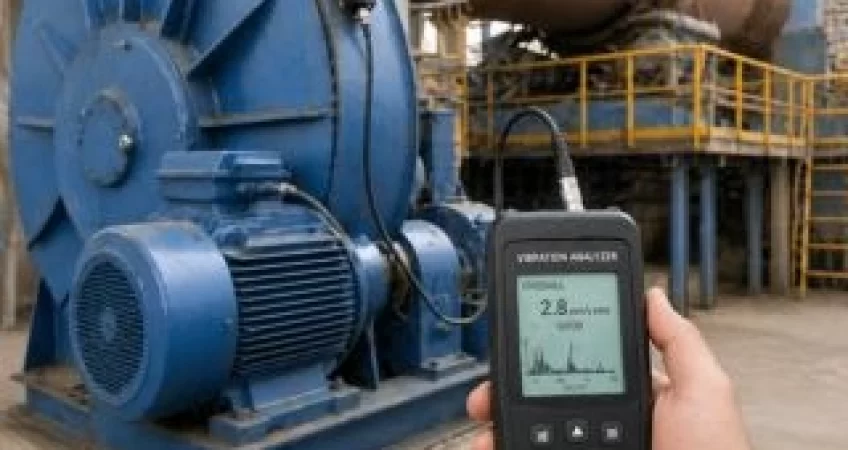
Vibration analysis is an established technique that is used to check the state of rotating machines. Every mechanical component generates a unique vibration signature during operation. Variations in this pattern typically suggest a developing problem, for example instability, looseness or damage to bearings.
In the context of integrating artificial intelligence, the analysis of vibration is significantly enhanced. Sensors that are installed in equipment constantly record high-frequency vibrations. AI algorithms process these data patterns to detect which can be used to detect abnormalities and identify potential issues. In contrast to manual analysis that relies on regular checks as well as human judgment, AI systems can analyze huge amounts of information in real-time and give precise information.
How AI Enhances Vibration Monitoring
AI-driven systems provide a level of speed and precision that traditional techniques cannot compete with. Continuous monitoring makes sure that even the most minor deviations in pattern of vibrations are spotted immediately. Machine model learning is based on the latest data and also historical ones which allows them to differentiate between normal operating variations as well as actual fault situations.
In the end, maintenance personnel receive alerts early regarding potential problems, usually days or weeks before the moment a malfunction takes place. This proactive strategy allows regular maintenance and reduces needless repairs and reduces the risk of the possibility of disruptions in production. Furthermore, AI systems reduce dependency of specialized human knowledge by automating the complex interpretation of data.
Application in Industrial Fans and Kilns
In industrial fans the use of AI-based vibration analysis allows for detection problems like the imbalance of blades, wear on bearings and airflow anomalies. When these problems are ignored, they could lead to excess vibration, energy loss eventually leading to failure. When they are able to identify these problems in the early stages, technicians can take appropriate action, without having to shut down the whole equipment.
The complexity is further increased due to the many interconnected parts such as girth gears, rollers and drive systems. AI systems are able to monitor the patterns of vibration across these parts for the purpose of detecting misalignment and wear on gears, as well as stress in the structural structure. The holistic approach to monitoring assures that possible failures are detected before they turn to costly break-downs.
Business Impact of AI-Driven Predictive Maintenance
Cost Savings, Downtime Reduction, and ROI
The introduction of AI-based vibration analysis yields tangible economic benefits. Through the shift from reactive to proactive maintenance, businesses will be able to reduce the risk of operational failure and increase the efficiency of their operations.
- Reduces downtime unplanned by identifying issues in the early stages
- Lowers the cost of repair and replacement by prompt intervention
- Increases the lifespan of equipment through preventing major damage
- Increases the overall productivity of the plant and operation efficiency
- Improves security by reducing the possibility of sudden equipment malfunctions
In terms of financials The return on investment usually occurs within an extremely short time. It is also worth noting that the cost of AI-based monitoring is much less than the risk of losing money due to one single equipment malfunction.
Implementation Challenges in Industrial Environments
However, even with its many advantages, using the use of AI to analyze vibrations isn’t uncomplicated. The initial investment cost are a major concern for certain organizations, particularly ones with limited budgets. Integration of new monitoring tools to existing systems need careful planning and the right technical knowledge.
There is also an insufficient understanding of the AI-driven information. Maintenance personnel may require training to be able to read alerts effectively and then take the appropriate action. Reluctance to change in conventional industrial structures can also delay the process of implementing.
Best Practices for Successful Deployment
In order to maximize the value of the AI-based vibration analysis process, companies need to adopt a strategic plan. Beginning with the most critical equipment like industrial fans or kilns can allow to win quickly and shows their value. The investment in quality sensors as well as reliable technology for data acquisition is vital to ensure accurate analysis.
It’s equally crucial to incorporate predictive insight in existing maintenance workflows. Collaboration among maintenance, operations teams and the data team ensures that the insights you gain are converted into actionable actions. Regular monitoring, regular assessment of systems, and employee education further increase the efficiency of the software.
Moving from reactive to Predictive Maintenance
The world of industry is changing quickly, and the traditional methods of maintenance are not enough to satisfy the needs of today’s. AI-based vibration analysis is an effective solution that allows earlier fault identification, reducing time to repair, as well as maximizing productivity.
With the help of predictive maintenance, businesses can transition from an approach that is reactive toward a proactive plan which focuses on reliability and savings. In an environment of constant competition, where each minute matters, the capability to predict and avoid breakdowns is not only an advantage, it’s a requirement.