
Table of Contents
- What Does “Water Neutral” Mean for a Cement Plant?
- Why Water Management Matters in Cement Manufacturing
- Major Sources of Water Consumption in Cement Plants
- Water Balance and Auditing: The Foundation of Water Neutrality
- Wastewater Treatment and Recycling
- Rainwater Harvesting as a Core Strategy
- Process-Water Optimization and Cooling-Water Management
- Dust Suppression Without Wasting Water
- Zero-Liquid-Discharge (ZLD) Approaches
- Smart Monitoring and AI-Based Water Optimization
- Challenges in Achieving Water Neutrality
- Measurable Benefits of Water Neutral Cement Plants
- Practical Steps Toward Water Neutrality
- Final Thoughts
Water Neutral Cement Plants are no longer a distant sustainability goal – they are becoming a business necessity. As water stress intensifies across manufacturing regions and regulators tighten discharge norms, cement producers are under growing pressure to consume no more freshwater than they replenish. For plant owners, process engineers, and sustainability heads, understanding how to achieve water neutrality is now central to long-term operational resilience.
This guide breaks down what water neutrality means in cement manufacturing, why it matters, and the practical steps plants can take to get there.
What Does “Water Neutral” Mean for a Cement Plant?
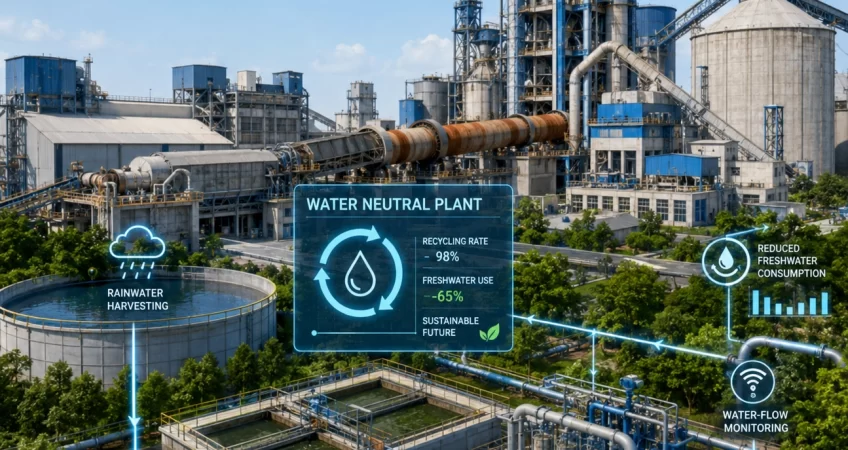
A water neutral cement plant is one where total water withdrawal from external sources is balanced by an equivalent volume of water returned to the environment, recycled internally, or replenished through harvesting and conservation initiatives. It is not simply about using less water – it’s about achieving a measurable net-zero impact on local water resources over a defined period, typically a year.
This concept sits alongside broader environmental commitments like carbon neutrality, and for many plants pursuing ISO 14001 certification or ESG reporting, water balance data has become just as scrutinized as emissions data.
Why Water Management Matters in Cement Manufacturing
Cement production is not as water-intensive as sectors like textiles or paper, but it is far from water-neutral by default. Key reasons water management has become urgent include:
- Regional water stress: Many cement plants operate in semi-arid zones where groundwater tables are already declining.
- Regulatory scrutiny: Pollution control boards increasingly mandate Zero Liquid Discharge (ZLD) compliance and water audits for new and expanding plants.
- Community relations: Local communities and farmers often depend on the same aquifers, making water use a social license issue, not just a technical one.
- Investor and buyer pressure: ESG-linked financing and green procurement policies now factor in water stewardship scores.
Plants that ignore this risk operational shutdowns, licensing delays, and reputational damage – all of which are more costly than proactive water management.
Major Sources of Water Consumption in Cement Plants
Before any plant can move toward water neutrality, it needs a clear picture of where water is actually being used. The primary consumption points include:
- Cooling systems for kilns, clinker coolers, and compressors
- Dust suppression at crushers, conveyors, and stockyards
- Domestic and sanitation use across plant and colony facilities
- Wet grinding processes, where applicable
- Gardening and greenbelt maintenance
- Boiler feed water, in plants with captive power or WHRS
Cooling and dust suppression typically account for the largest share of consumption in dry-process cement plants, making them the natural starting point for optimization.
Water Balance and Auditing: The Foundation of Water Neutrality
You cannot manage what you don’t measure. A comprehensive water balance study maps every input (borewell, municipal supply, rainwater) against every output (evaporation, discharge, product-embedded water, leakage). This is typically done through:
- Metering all major intake and discharge points
- Tracking seasonal variation in consumption
- Identifying non-revenue water loss from leaks and inefficient equipment
- Benchmarking specific water consumption (litres per tonne of cement) against industry norms
Third-party water audits, often aligned with guidance from the Confederation of Indian Industry’s water stewardship programs, give plants a credible baseline to measure progress against and report to regulators or ESG auditors.
Wastewater Treatment and Recycling
Treating and reusing wastewater is one of the fastest ways to reduce net freshwater intake. Common approaches include:
- Effluent Treatment Plants (ETPs) for domestic and process wastewater
- Reverse osmosis (RO) systems to recover reusable water from blowdown streams
- Reuse of treated water for dust suppression, road wetting, and greenbelt irrigation instead of discharging it
Recycled water rarely needs to meet drinking-water standards for these secondary uses, which makes treatment-and-reuse loops both technically feasible and cost-effective.
Rainwater Harvesting as a Core Strategy
Rainwater harvesting is often the single largest lever for achieving water neutrality, particularly for plants with large paved and roof areas. Effective systems typically include:
- Rooftop collection channelled to storage tanks or recharge pits
- Check dams and percolation ponds within plant boundaries
- Groundwater recharge structures that directly offset borewell withdrawal
Guidance from India’s Central Ground Water Board provides technical standards for designing recharge structures suited to local hydrogeology – an important reference point during plant-level water audits.
Process-Water Optimization and Cooling-Water Management
Optimizing process water often delivers quick wins without major capital investment:
- Converting once-through cooling systems to closed-loop circuits
- Installing air-cooled condensers where feasible to reduce evaporative losses
- Upgrading to high-efficiency clinker coolers that need less water for heat exchange
- Regular leak detection and pipeline maintenance across the plant
Cooling towers, in particular, benefit from cycles-of-concentration optimization, which can cut blowdown volumes significantly with minimal disruption to operations.
Dust Suppression Without Wasting Water
Dust suppression is essential for both compliance and worker health, but traditional water-spray systems are inefficient. Better alternatives include:
- Fog cannons and misting systems that use a fraction of the water of open spraying
- Chemical dust suppressants for haul roads and stockpiles
- Enclosed conveyor systems that reduce the need for suppression altogether
These measures reduce both water consumption and particulate emissions simultaneously, supporting compliance frameworks referenced by the Global Cement and Concrete Association.
Zero-Liquid-Discharge (ZLD) Approaches
ZLD systems treat all wastewater to the point where it can be fully reused, leaving no liquid effluent for external discharge. While capital-intensive, ZLD is increasingly mandated for plants in water-stressed and industrially dense zones. A typical ZLD train includes pre-treatment, membrane filtration, evaporation, and crystallization to recover both water and residual solids for safe disposal or reuse.
Smart Monitoring and AI-Based Water Optimization
Digital tools are transforming water management from a periodic audit exercise into continuous, data-driven control. Modern plants are deploying:
- IoT-based flow meters across intake, process, and discharge points
- AI-driven anomaly detection to flag leaks or abnormal consumption in real time
- Predictive analytics that correlate water use with production schedules for proactive optimization
These systems typically pay for themselves within 12–18 months through leak reduction alone, while also generating the granular data needed for ESG disclosures and Rank Math-style reporting dashboards used internally by sustainability teams.
Challenges in Achieving Water Neutrality
Plants pursuing this goal commonly face:
- High upfront capital cost for ZLD and RO infrastructure
- Seasonal rainfall variability affecting harvesting reliability
- Retrofitting constraints in older plants with limited space
- Coordination challenges between operations, environment, and finance teams
None of these are insurmountable, but they do require a phased, well-sequenced implementation plan rather than a single large investment.
Measurable Benefits of Water Neutral Cement Plants
The return on investment extends well beyond compliance:
- Lower specific water consumption (litres per tonne of cement), directly cutting operating costs
- Reduced regulatory risk and faster environmental clearances for expansion
- Improved ESG ratings, which increasingly influence access to green financing
- Stronger community relations in water-stressed operating regions
- Resilience against water scarcity, reducing production downtime risk
Practical Steps Toward Water Neutrality
- Commission a comprehensive water balance audit as the baseline
- Set a specific, time-bound water neutrality target (e.g., net-zero withdrawal by a defined year)
- Prioritize high-impact, low-cost fixes first – leak repair, cycles-of-concentration optimization, fog-based dust suppression
- Phase in rainwater harvesting and recharge structures aligned to local hydrogeology
- Scale up to wastewater recycling and ZLD systems as capital allows
- Deploy smart metering for continuous monitoring and reporting
- Review and report progress annually against recognized frameworks
Final Thoughts
Water Neutral Cement Plants represent a realistic, achievable target when approached systematically – starting with accurate measurement, followed by targeted interventions across cooling, dust suppression, and wastewater streams. Plants that begin this journey now will be better positioned for regulatory compliance, investor confidence, and long-term operational stability.
Techcem Consulting and Engineering works with cement manufacturers on end-to-end water audits, ZLD system design, and sustainability strategy through our cement plant consultancy services, helping plants translate water neutrality goals into implementable, cost-effective plans. Explore our environmental and sustainability consulting offerings to begin your plant’s water balance assessment.